
12 STATIONS
A LAND ART / STREET ART PROJECT BY BURNINGMAX
SITE-SPECIFIC INSTALLATION
IN A RESIDENTIAL PUBLIC PARK
VIA ADOLFO GREGORETTI
LIDO DI OSTIA, ROME
PART OF THE INITIATIVE BY THE CITY OF ROME
ROMA CURA ROMA, MAY 2026


THE PROJECT
Keep scrolling to discover all details about the 12 STATIONS project, included technical info, or just click the menu links here below to go straight to the sections that interest you the most.
Intro
Burningmax in Ostia
Paradise is not forever
The deforestation of Via Gregoretti
DETAILS
Project drafTS
Project naming
Primary, secondary and remixed colours
Art References and Inspirations
Production steps
Production hiccups
THE INSTALLATION
The 12 Stations
Photo gallery
Thank You
Contacts

INTRO
BURNINGMAX IN OSTIA
I moved to Rome in 1990 from Palermo, a city with a full seafront, and I was immediately drawn to Lido di Ostia, leaving often the city to go to the beach.
I began visiting Ostia more frequently when my parents bought a small apartment with a terrace, a few blocks from the beach but on a quiet, side street. Its main feature was a beautiful residential green space with magnificent centuries-old Mediterranean pine trees, Via Gregoretti.
READ MORE
BURNINGMAX IN OSTIA
I moved to Rome in 1990 from Palermo, a city with a full seafront, and I was immediately drawn to Lido di Ostia, leaving often the city to go to the beach.
I began visiting Ostia more frequently when my parents bought a small apartment with a terrace, a few blocks from the beach but on a quiet, side street. Its main feature was a beautiful residential green space with magnificent centuries-old Mediterranean pine trees, Via Gregoretti.
There’s no sea view from the terrace, but since there’s no traffic noise like in Rome, you can hear the sound of the waves. While the view from the fifth-floor terrace, well above treetop height, was of a splendid, uninterrupted “sea of green” of trees, with very few buildings peeking out in the distance,
My parents used the Ostia apartment mainly on weekends in spring and fall, a little more in summer, but only until July, because they loved spending the height of summer in Sicily. Since the apartment was almost always empty, it didn’t take long before my stays in Ostia became increasingly extended, especially in winter.
Having returned to Rome in 2017, after living abroad for a long time, I needed an outdoor space to work on some artistic projects, and I began doing longer residencies in Ostia starting in 2018. It was on the terrace of my apartment in Ostia that I processed most of the materials for my projects Apelle (2018) and 50 Shades of Green (2019) – productions that were later completed at Villaggio Globale in Rome, since I was still essentially living in Rome.
With the Covid lockdowns of 2020, I decided to move to Ostia. Not only to have more nature and less traffic around, but also to enjoy the terrace instead of being cooped up in a city apartment. In 2021, I also needed a space to work on various projects (Breathe, Lung-Ta, Holy Shit!), and by then I had Davola, a handsome dog who loves Ostia more than Rome.
Being a Labrador, Davola obviously loves the beach, but he’s also always been happy to roam and play in the park below, where we took (and still take) endless walks. He loved and recognized (and peed on) every pine tree, chasing every pine cone he found along the way.
And that’s how I became a full-time Ostia resident. Then, due to my recent health problems, with four hospitalizations and three surgeries at Grassi Hospital, plus three long rehabilitation stays at the CPO (all in the last three years), I feel even more “integrated” in Ostia than ever.

Paradise is not forever
In 2024, the magnificent pine trees of Ostia, as well as those of the nearby Castel Fusano Reserve, were infested by a deadly insect, the cursed cochineal. The insect spread rapidly, slowly killing most of the trees in the area. Literally, “slowly killing.” The trees didn’t die instantly, but gradually withered and died over the course of about two years.
12 Stazioni is a commemorative installation in honor of all the trees we have lost in Ostia, and a “personal memorial” to honor Davola, the main source of inspiration for this project.
READ MORE
Paradise is not forever
In 2024, the magnificent pine trees of Ostia, as well as those of the nearby Castel Fusano Reserve, were infested by a deadly insect, the cursed cochineal. The insect spread rapidly, slowly killing most of the trees in the area. Literally, “slowly killing.” The trees didn’t die instantly, but gradually withered and died over the course of about two years.
Not all the trees died, because there was a way to save them: a “deep disinfestation” procedure. The tree trunks were drilled three or four times, and a bag was inserted into each hole that slowly released a disinfectant liquid. Like an IV, the kind I get at every hospital admission.
Except that, for some reason, it was decided that only a few trees, mostly those on the central streets of Ostia, deserved the disinfestation treatment. The rest of the trees were abandoned to their fate of certain death, especially those in secondary residential areas with little traffic. And those in the Castel Fusano Reserve, where if the trees were people, one might call them “extermination.” Hundreds (thousands?) of trees were cut down.
Because, you know… if a tree falls in the woods, who’s going to know? Except that in this case, the extent of the deforestation is clearly visible to anyone entering and leaving Ostia, and even more so to the hundreds of people who regularly use the trails of Castel Fusano to jog, walk their dogs, exercise, or just go for a walk. The “extermination of the trees of Castel Fusano” occurred in the spring-summer of 2025.
In the fall-winter of 2025, the trees in the residential garden of my apartment building in Ostia were also felled. More than 15 trees in less than 200 meters. Plus another 10 trees on the rest of Via Gregoretti, roughly the same number on the parallel street, and about a dozen on Via Capitan Casella, even though it was a main Ostia Sud road. And this is just within a couple of blocks of where I live. The “urban deforestation” has unfortunately affected all of Ostia.
I personally witnessed the deep-seeded tree disinfestation operations, and I saw the number of men, resources, and time required to “cure” each individual tree. I also closely followed the operations, the number of workers, trucks, cranes, chainsaws, and the subsequent street clearing required to fell the trees. I may not be an expert in administration, but I think I can safely say that cutting down and removing the trees from the streets must have been enormously more expensive than treating them. But that’s not what the project is about.
From the terrace, I can no longer see the “green sea“; only a couple of trees, and the rest of the view is just buildings. Davola continues to urinate on the trunks of the felled trees, but there are no pine cones left.
This project is a commemorative installation in honor of all the trees we lost in Ostia.
12 Stations is a project that focuses on local environmental issues, such as Ostia’s loss of the centuries-old pine trees population. and the general state of abandonment and degradation of public green areas (in Ostia as well as in Rome).
UPDATE (May 23, 2026)
Sadly, ten days after the project was completed, Davola passed away. He was a beautiful 13-year-old Labrador Retriever, my inseparable companion and the source of inspiration for the project itself (details to follow). Half of his ashes were scattered at sea, on his favorite beach; the other half were scattered in our home park, which he also loved, near two of the trees he loved to pee on most, those corresponding to Stations 1 and 12 of the installation. For this reason, at least on a personal level, 12 Stations is also a project officially dedicated to Davola’s memory.

The deforestation of Via Gregoretti
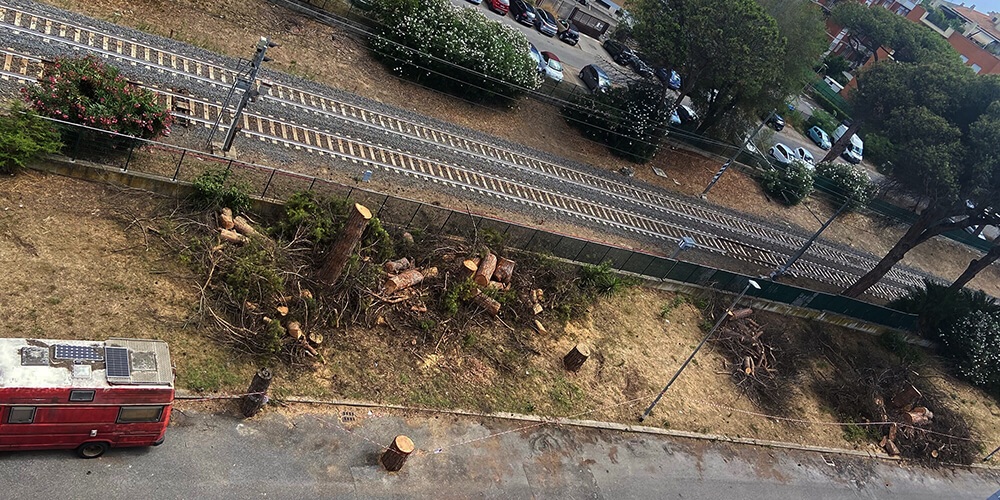
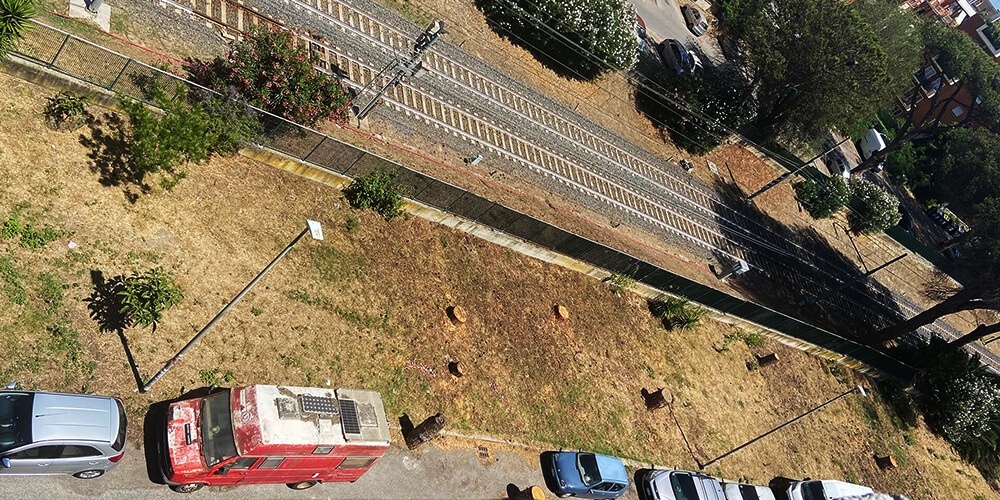
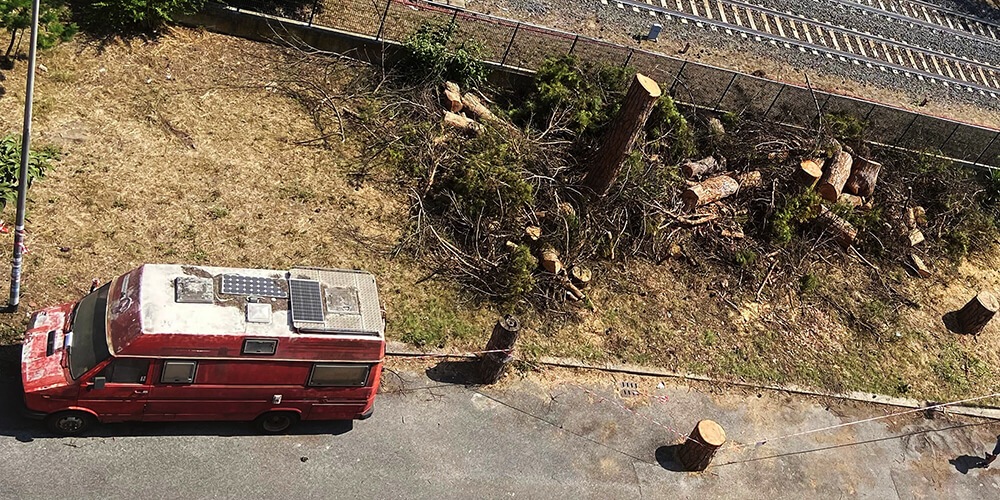
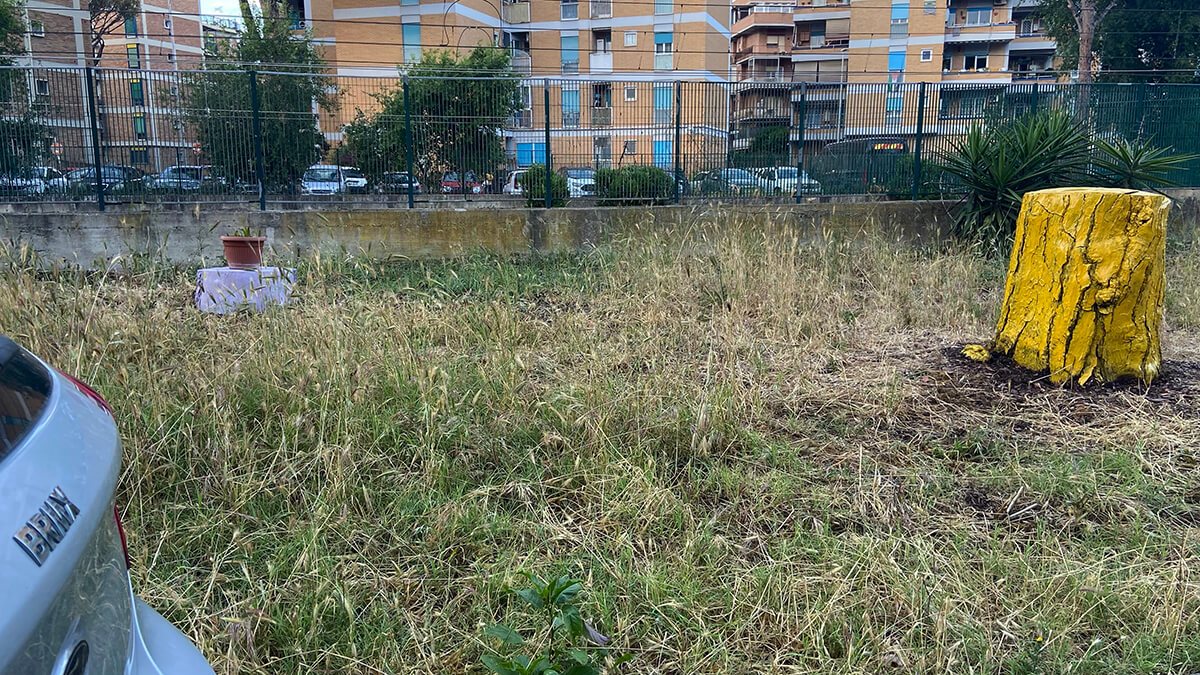
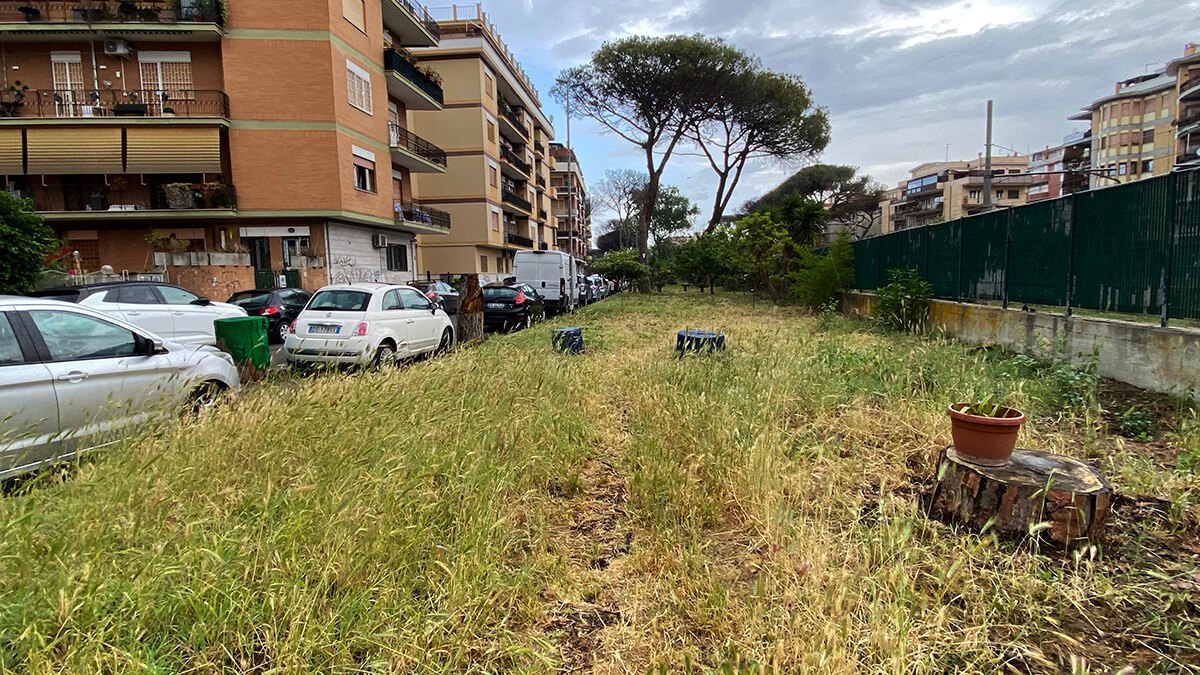
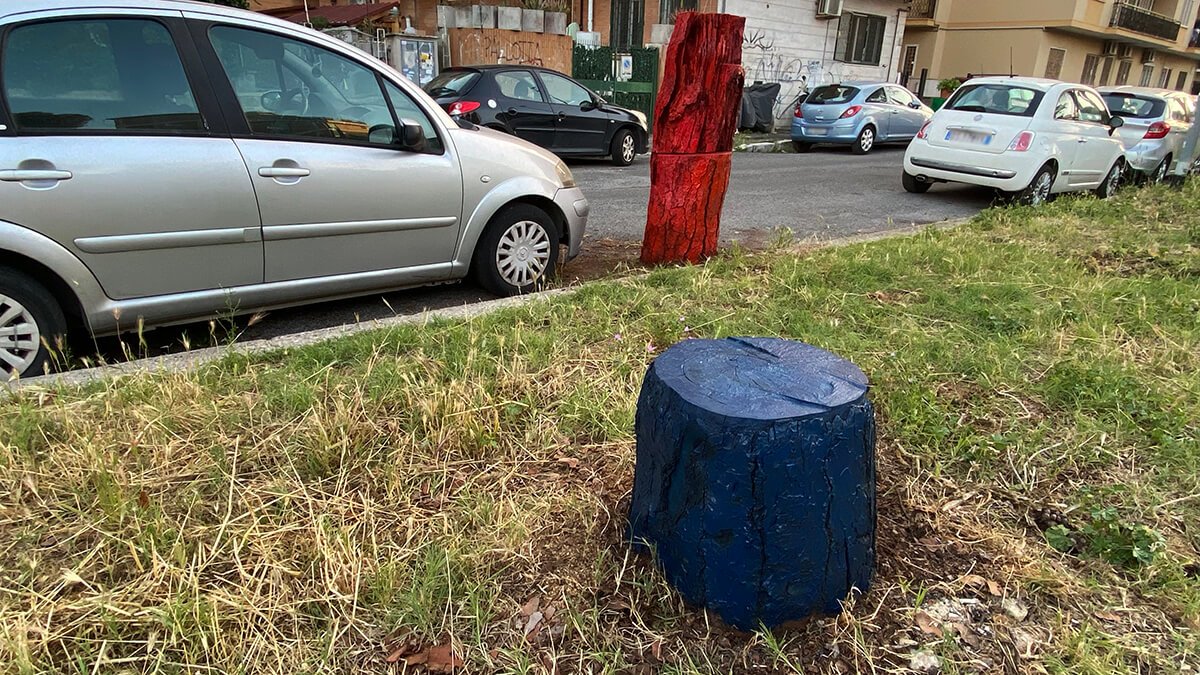
This is what is left of the the pine trees park of Via Gregoretti after the trees were cut down. The devastation left by the urban deforestation operation is very visible.
These photos don’t show the entire installation area, but you can see that the pine grove has disappeared.


As we all known, it’s possible to calculate the age of trees by counting the growth rings on the cut trunk. I did just that. I counted the rings to figure out how old the cut trees were. The youngest was almost 80 years old, one of the largest was older. I lost count after 140 rings; I think it was between 150 and 160 years old. What a shame…
The photos were taken after the first pine removal on Via Gregoretti. Other trees were cut down in the following days. Several trees on the other side of the tracks (Via Bertolotto) were cut immediately afterward. The same thing happened everywhere in Ostia.
The old red camper in the photos was my faithful companion on so many travels and adventures around the world.
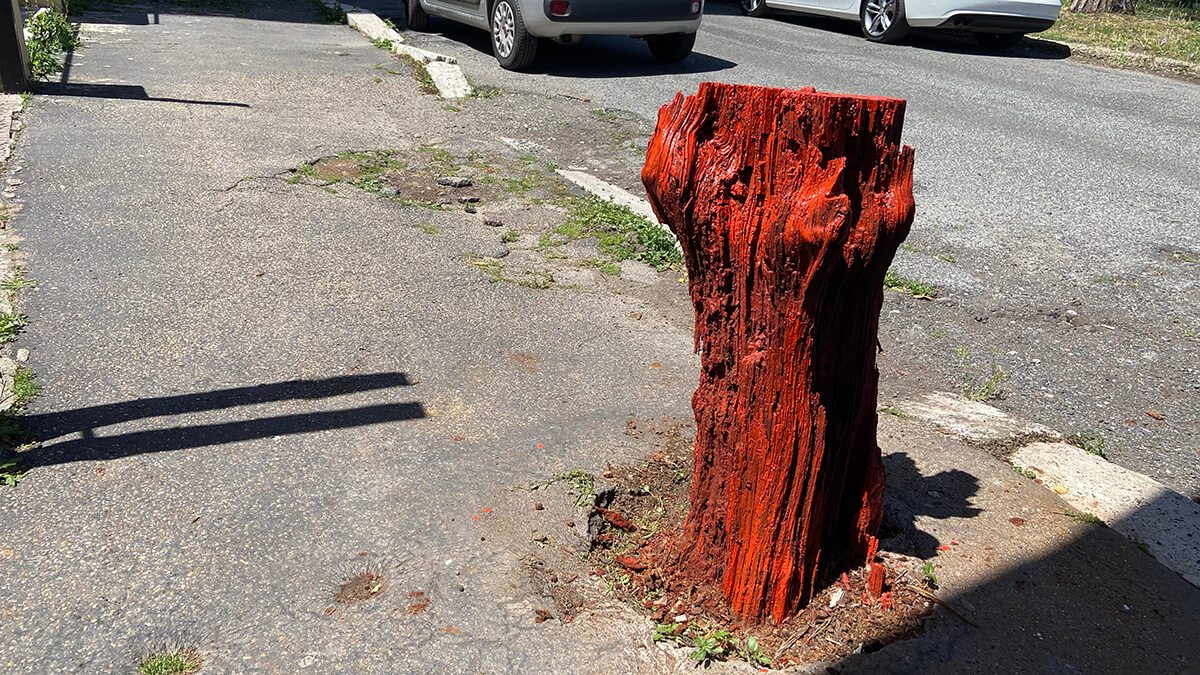
I had to part with it and scrap it last year, after I left it parked for years in the shade of one of the trees. In memory of the camper (that Davola and I called casita con ruedas), I have painted that tree stump red.


DETAILS
PROjecT draftS
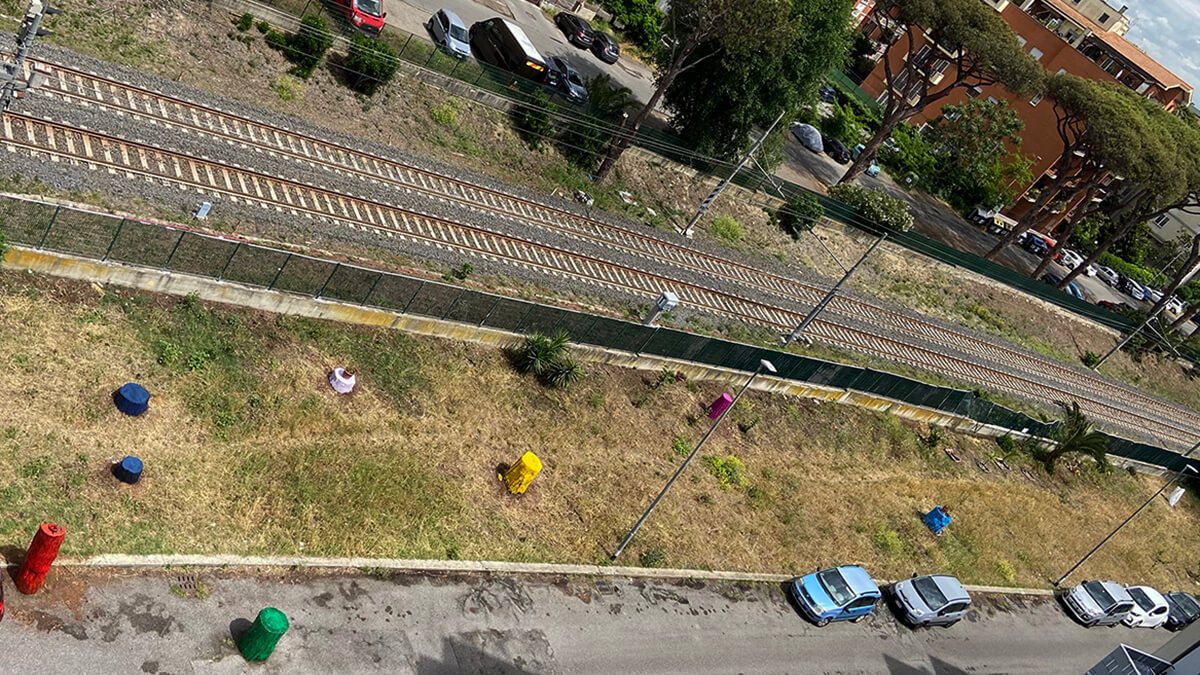
In the sketch above, the green area is the park, specifically the approximately 200-meter section where most of the trees have been cut down, in front of my house. Some trees were rooted in concrete and, as in other areas of Ostia, were a bit “in the way,” but we (the local residents) loved them. The trees growing from the asphalt are those in the gray area. One of the trees is rooted directly on the sidewalk, the light gray area below.
The upper and lower sections are areas outside the installation area: the upper section is the double railway track for the MetroMare trains connecting Ostia and Rome, while the lower section is the side of Via Gregoretti occupied by buildings. The colored numbered dots are the elements of the installation, the 12 Stations, coinciding with the trunks of the cut trees. The colors provided in the draft are (approximately) those used for each station.
In the image below, I used Google Maps, which has a satellite memory of the removed trees, and re-mapped the image to show the extent and scale of the installation.

PROJECT NAMING
12 Stations? What is it all about? The project name “12 STATIONS”, temporary at first, later became definitive, but there were 4 more candidates, many inspired by my dog’s reaction to the disappearance of the trees, but not only…
THE 12 STATIONS OF…
The first name that came to mind, “12 Stations,” was inspired by noticing that my dog kept looking for trees after they had been cut down, because he wanted to pee on them. In the days following the deforestation, he continued to visit all the remaining stumps, sniffing them one by one, as if he was following a personal olfactory “Via Crucis,” where the missing trees were his personal “pee stops.” Speaking of stations and stops, it should be noted that my MetroMare station (Stella Polare) is 12 stations from the Porta San Paolo terminal in Rome. After much consideration, “12 Stations” is the name I chose for the project.
REGINA VIARUM URINAE
In connection with the Via Crucis, I thought of another great road my dog loved to explore, the Via Appia Antica, recently included in the list of UNESCO World Heritage Sites. In ancient Rome, the Via Appia was the “Regina Viarum,” the “queen of roads.” In honor of Davola, I mentally renamed the path among the lost trees as “the queen road of pee“, “Regina Viarum Urinae” in latin. It was a fun thought process, but it didn’t pass.
GHOST TREES PARK
While my dog continues to search for the lost trees, I know I’ll never see them again. And I miss them. The day after the deforestation, looking from the terrace at what was once a green park, I saw nothing but devastation. For weeks, before the weeds began to grow again, erasing the mess created by tree cut machinery, trucks, and cranes, I called the garden “the Gaza Strip.” Davola and I, like all the other residents of the neighborhood, still use the garden every day, but now we no longer see the trees, only their “ghosts.”
COLLECTIVE MEMORY
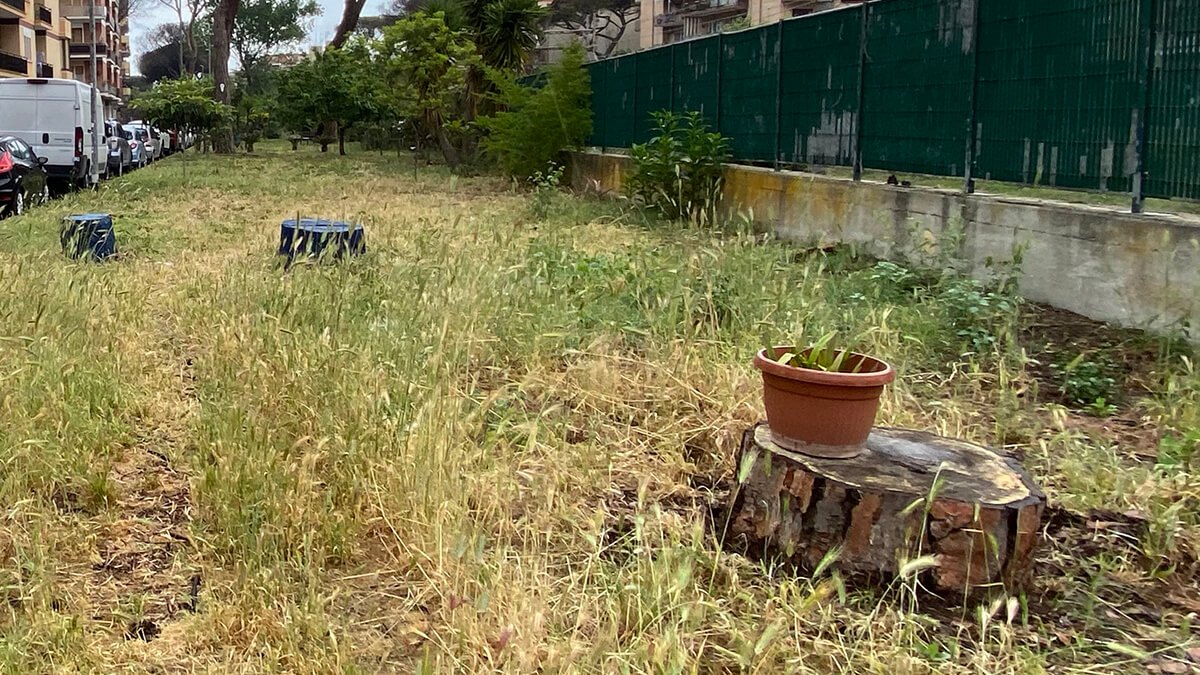
I’m not the only one who misses the trees. Many neighbors are committed to improving the park, which is always in a state of neglect, both in terms of cleaning and maintenance. Some neighbors have planted trees, plants, created a rose garden, and installed benches. Others have tried to soften the visual impact of the cut trees by placing flower pots on the tree stumps. In the past, when my health still allowed it, I too have cleaned the park several times, armed with grabbing toole, gloves and garbage bags. Now I’d like to transform the stumps into colorful memories of what the park once was. A colorful collective memory.
MEMORY OF THE SHADOWS
Continuing the theme of memory and loss, I also thought about how much I will miss the cool shade offered by the now missing trees, and the wonderful play of shadows they created, which changed with the seasons and the time of day. This is how the last candidate name for the project was born.

PRIMARY, SECONDARY AND REMIXED COLOURS
As with most of my previous works, I initially decided to use primary and secondary colors to paint the tree stumps, using acrylic paint to achieve vibrant results in the sunlight.
When I paint objects to be placed in natural settings, or apply colors to the environment, I generally use natural, biodegradable, and non-toxic pigments and dyes, which tend to fade over time, and are no harm for the environment.
For 12 Stations, I used industrial acrylic paint, only because the trees are already dead. Also, with no more shade in the park, the stumps are exposed to direct sunlight, and no pigment could withstand the summer sun, and will fade at the first rains.

READ MORE
PRIMARY, SECONDARY AND REMIXED COLOURS
As with most of my previous works, I initially decided to use primary and secondary colors to paint the tree stumps, using acrylic paint to achieve vibrant results in the sunlight.
When I paint objects to be placed in natural settings, or apply colors to the environment, I generally use natural, biodegradable, and non-toxic pigments and dyes, which tend to fade over time, and are no harm for the environment.
For 12 Stations, I used industrial acrylic paint, only because the trees are already dead. Also, with no more shade in the park, the stumps are exposed to direct sunlight, and no pigment could withstand the summer sun, and will fade at the first rains.
The colors I chose and associated with the trees, based on my memories and related personal moods, are:
PRIMARY COLORS
Red (bright)
Blue (saturated)
Yellow (saturated)
SECONDARY COLORS
Green (blue + yellow)
Cyan (blue + white)
Purple (blue + red)
Orange (red + yellow)
White (pure)
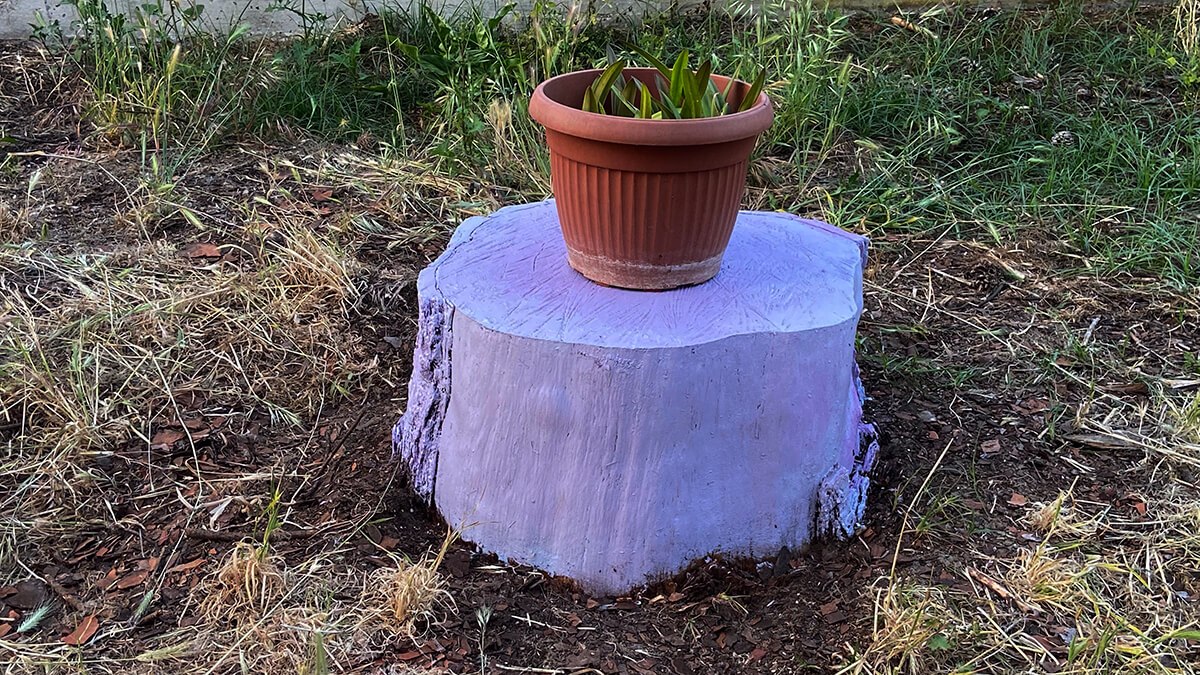
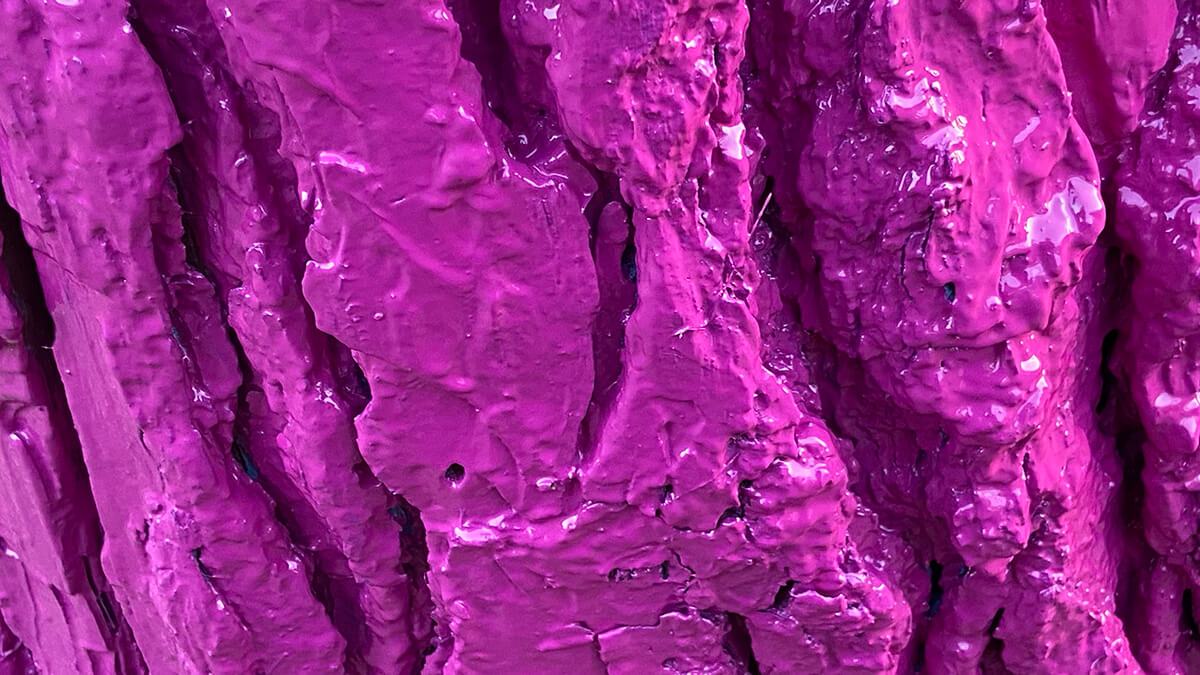
During a phase of “experimentation” in the field, dictated by budget constraints, we remixed the leftover paints (recycling) for the production of Station 7. The result of the color remix was a “striped unicorn pink,” which, after much consideration, we liked and decided to leave as is.

ART REFERENCES AND INSPIRATIONS
This project is the result of various references and inspirations. Which, incidentally, are among the most recurring references for most of my art projects. Let’s just say this is my starting point.
READ MORE
ART REFERENCES AND INSPIRATIONS
This project is the result of various references and inspirations. Which, incidentally, are among the most recurring references for most of my art projects. Let’s just say this is my starting point.
The references and personal inspirations for this project come from various sources: from Marcel Duchamp (objets trouvés, the dead trees) and Arte Povera (objets trouvés, but in the woods), to everything I’ve explored, assimilated, and created in the field of Land Art. And obviously also Pop Art, for its aggressive use of color and its “celebration” of the ordinary. Kudos to you all.
In the world of Land Art, one of the most direct inspirations for this work comes from Árboles como Arqueología, a majestic installation by Bolivian artist Fernando Casás, which dominates an entire quadrant of the Spanish desert of Los Monegros (north of Zaragoza, in the province of Huesca). Casás installed a series of sculpted granite monoliths on a desert cliff, a reminder that the desert was once covered with forests, now lost due to the bombings of the Spanish Civil War, which desertified the area.
Orbs as Archaeology was the inspiration for another land art project of mine created in the Monegros (Orwell Monegros Project, an installation in the trenches where George Orwell fought, and in parallel at the CDAN Museum in Huesca – 2015-2019). The affinity with Fernando Casás’s work was dictated by the connection to the territory and shared references to the Spanish Civil War, but I must admit that Casás’s installation in the Monegros desert is a better fit in terms of inspiration and intent for 12 Stations. Muchas gracias, Maestro.
I see a common thread between this project and my other previous land art installations, especially the two 2018 installations Apelle (Bacoli, Naples) and The Zone (Campicozzoli, Florence), or the more recent Breathe (Villa Ada, Rome – 2021); which, paradoxically, celebrated life in trees, making them “breathe” with color.
Among my constant sources of inspiration and artistic references, I never tire of citing Christo and Jeanne-Claude. For this project, the French couple’s inspiration comes from The Gates (Central Park, New York), the double installation The Umbrellas (Japan and the United States), and of course the iconic project Wrapped Trees (Switzerland). Merci également à vous deux.
I also include Katsushika Hokusai as a reference, at least for the name of the project. I recently visited a Hokusai retrospective in Rome, and among the works created by the Japanese master (including the famous Great Wave off Kanagawa, part of the 36 Views of Mount Fuji series), I loved the series entitled “The 53 Stations of the Tōkaidō Way.” One of the first names in the draft project was “The 12 Stations of Gregoretti Way.” Dōmo arigatōgozaimasu, Sensei.
Not on the artistic side, but on the “post-surgical resilience” side, I would also include Frida Khalo among the inspirations, who had more complex surgical adventures than mine, but from which she drew inspiration for her art. I’ve often thought about Frida and how she must have approached her creative process, every time I gritted my teeth in pain to “get by“, or when I had to “make do” with crutches and difficulty walking. Muchas gracias, Frida.
Prince has been a direct influence on Station 10 ever since, studying the trunk before the surgery, I remembered “I only want to see you bathing in the purple rain“. Thank you, Prince.
Finally, I began planning the project on April 20, 2026 – 420 Day. A coincidence, but a significant one, given that I pay homage to the plant kingdom.

PRODUCTION STEPS
The project was conceived on April 20, 2026, and was initially planned to be realized as a “street art” project, that is, in an autonomous, spontaneous, and direct manner.
The idea for the project came to me after a morning walk with Davola, while I was sitting on the bench near what would become Station 1, reflecting on the absence of the tree near the bench, while Davola peed on the cut trunk.
READ MORE
PRODUCTION STEPS
The project was conceived on April 20, 2026, and was initially planned to be realized as a “street art” project, that is, in an autonomous, spontaneous, and direct manner.
The idea for the project came to me after a morning walk with Davola, while I was sitting on the bench near what would become Station 1, reflecting on the absence of the tree near the bench, while Davola peed on the cut trunk.
The project was conceived on April 20, 2026, and was initially planned to be realized as a “street art” project, that is, independently. I spent the rest of the morning taking photos and taking measurements, then I went to purchase paints and materials (about €150 in total), and dedicated the entire afternoon to creating sketches of the installation and mulling over the conceptual aspects of the project.
From the idea to the site inspection, planning, and purchasing of materials, everything happened in less than 24 hours, and the project could have been realized and completed with just a few hours of work the following day. Unfortunately, due to health problems and unfavorable weather conditions, I was forced to postpone the project by a few days. In the meantime, the “pre-production” activity continued.
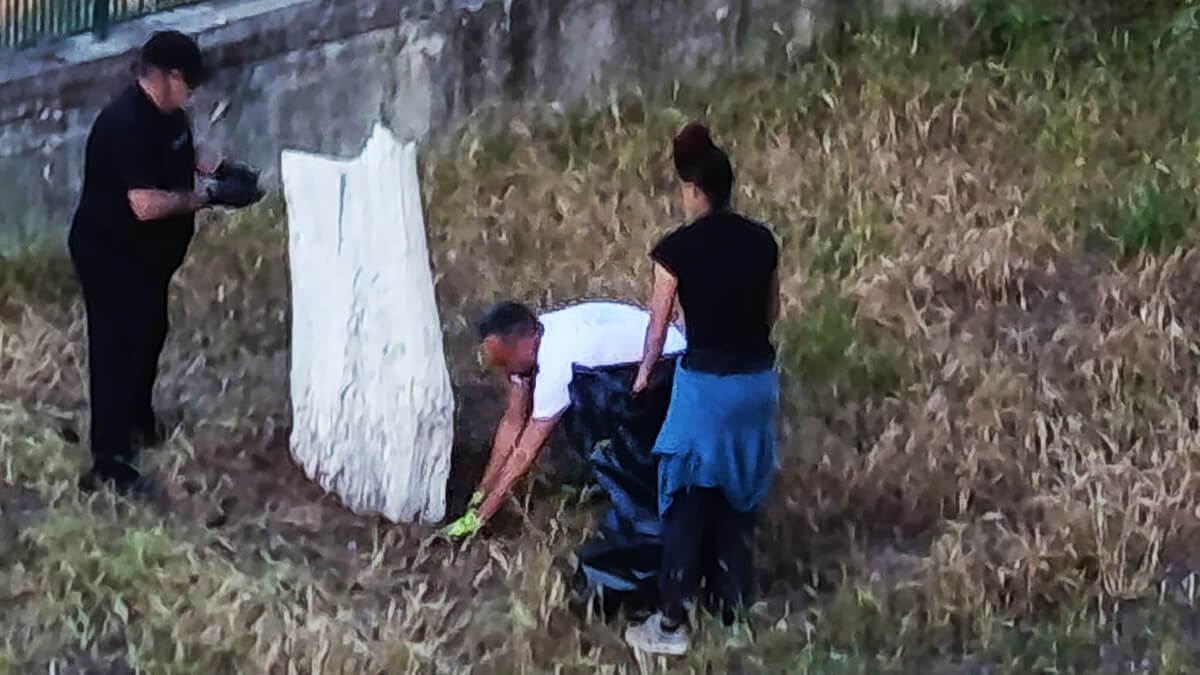
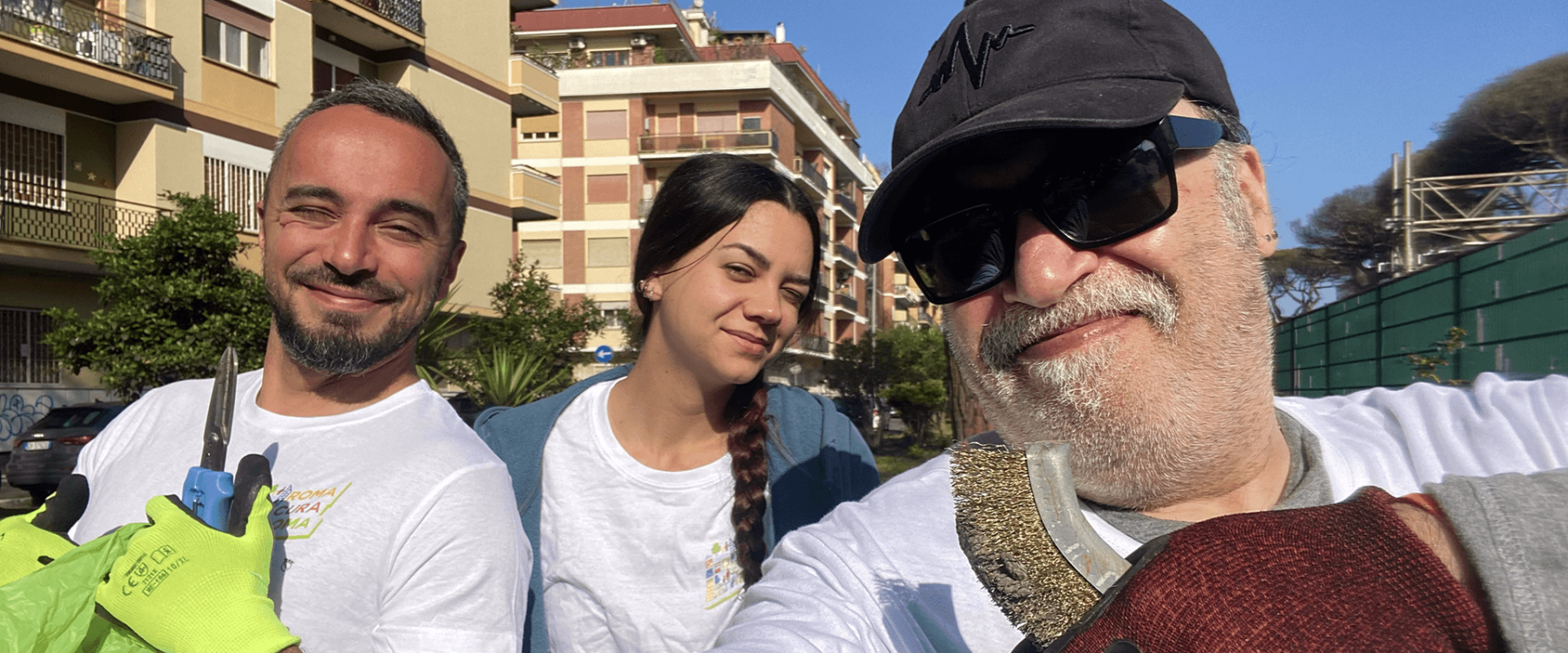
Over the weekend of April 25-26, the first step in the process was initiated, with a cleaning of the tree stumps to prepare them for painting. The cleaning was carried out with the support of my assistants Arianna, who lives a couple of blocks away from me, roughly at the height of Stazione 12, and Franco, also a resident of Ostia.
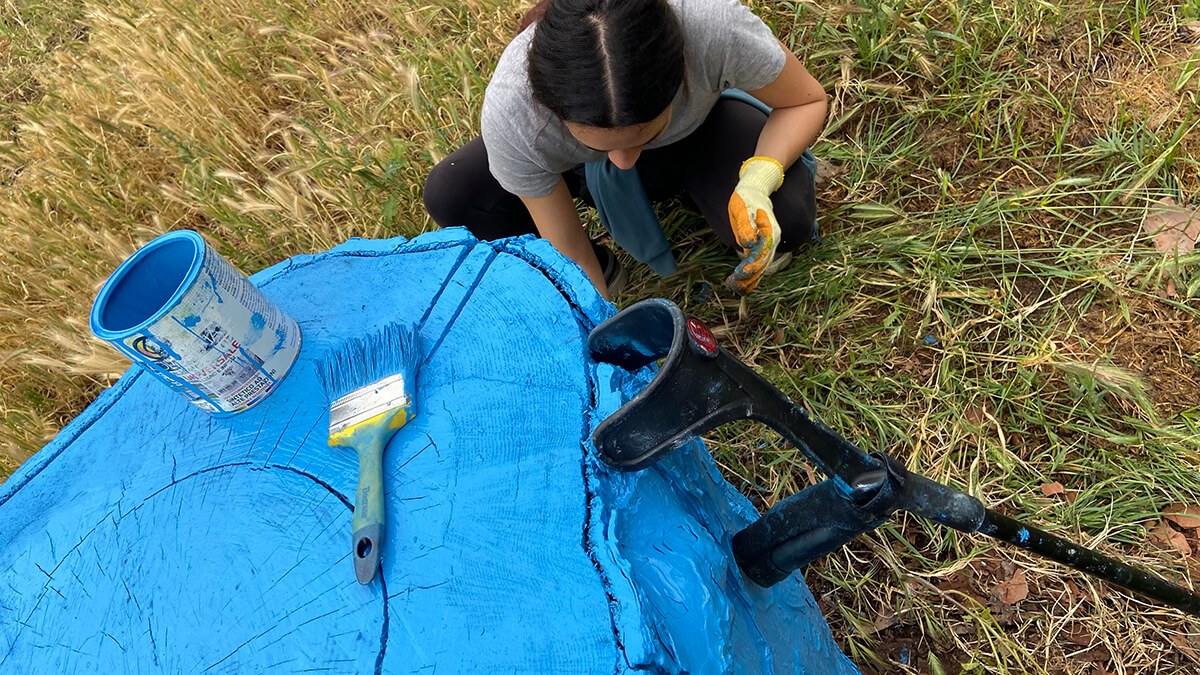
Armed with gardening gloves, garbage bags, shears, and brushes, we cleaned the 12 tree stumps, removing dirt, cobwebs, dust, and the like. We also removed weeds growing close to the trunks to prevent them from obstructing the painting process, and we also removed some of the garbage, unfortunately always present in the park, but only to clean our work areas. Before painting the trunks, a final cleaning of the trees was carried out with brushes and compressed air.
The final documentation of the project (photos of all 12 renovated Stations) was expected in the days following the intervention, in optimal lighting conditions for photographic documentation.
Everything was ready for the independent street art project when, on April 28, I received the newsletter from the City of Rome, announcing the organization for May 9, 2026 of Roma cura Roma, a widespread participation initiative focused on urban decor interventions and cultural initiatives in various neighborhoods of Rome. There was no better place to propose the artistic project of revitalizing the residential green space on Via Gregoretti.
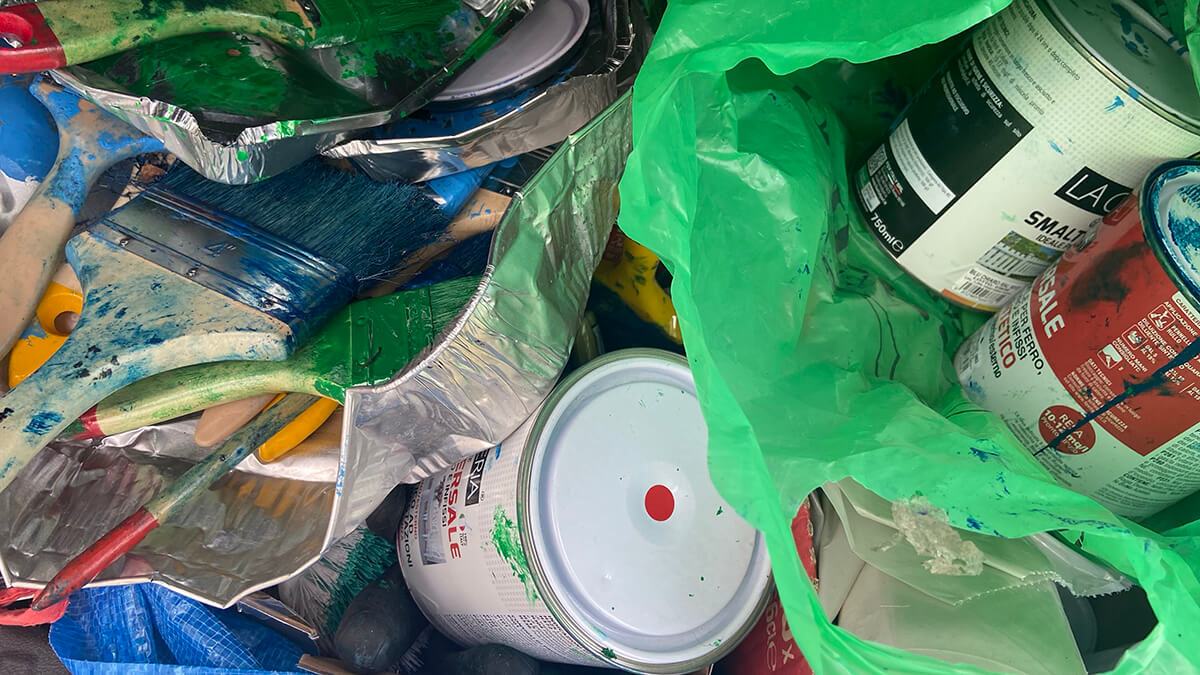
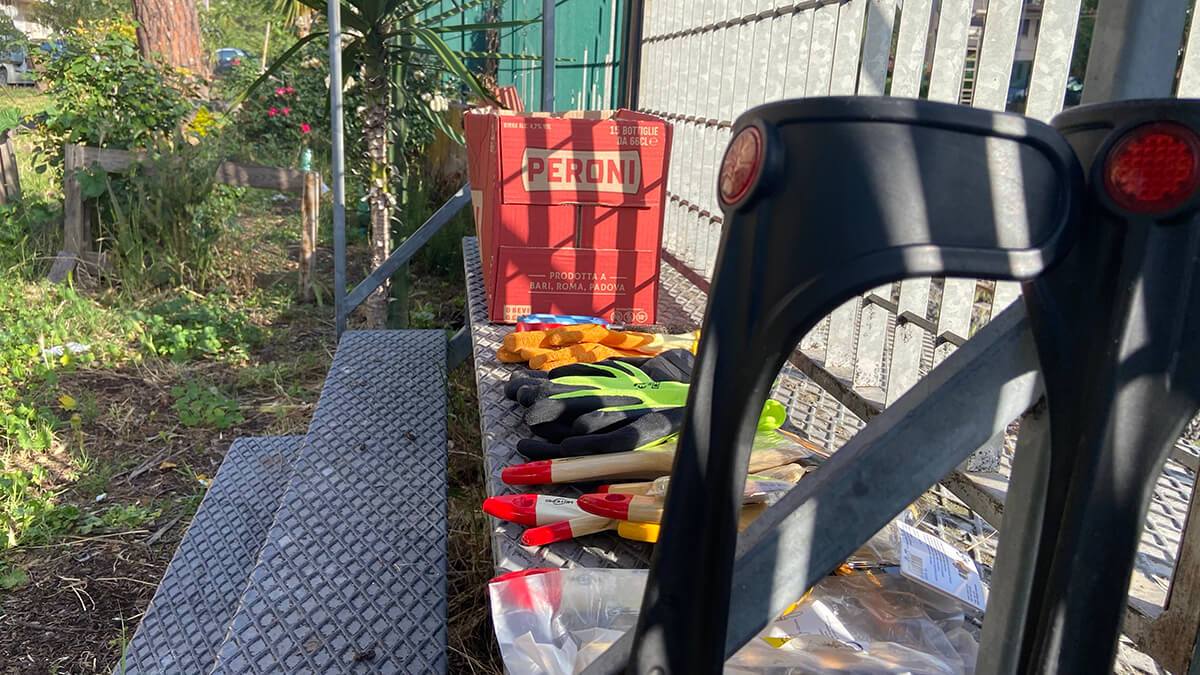
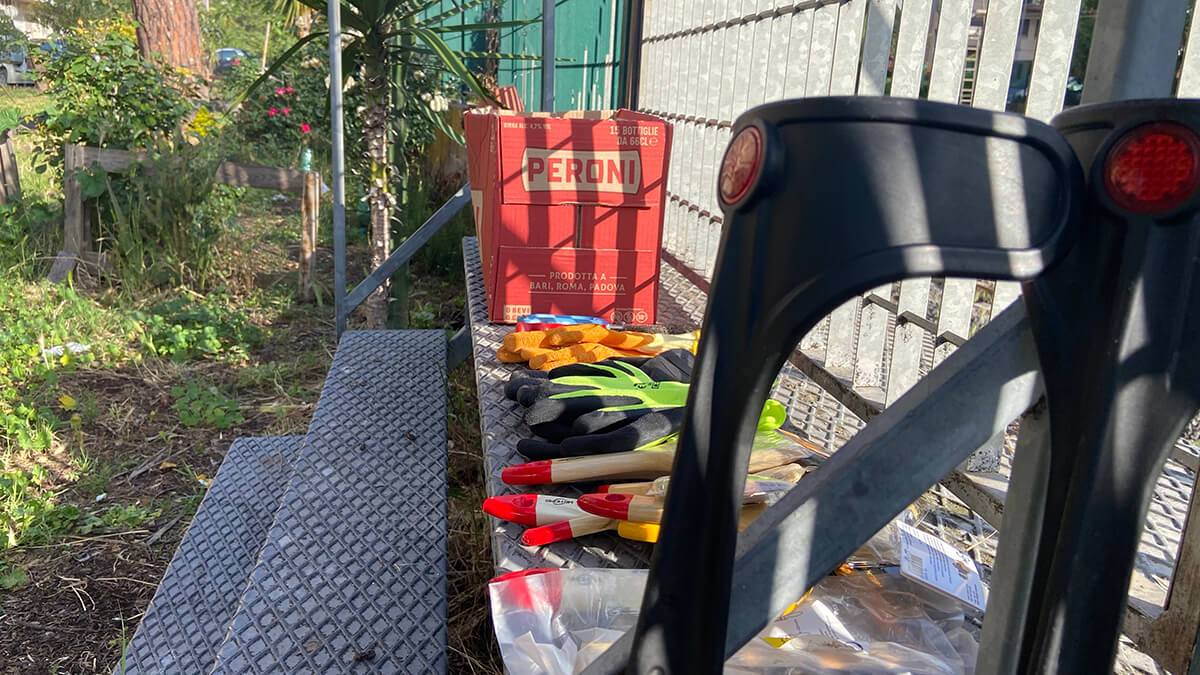
I joined the initiative immediately after reading the newsletter and the participation procedure. It was great that the City of Rome offered to supply the materials needed for the project, so I requested paints, brushes, gloves, and garbage bags; materials already purchased and self-financed, but not in sufficient quantities. Unfortunately, however, the only materials received from the City of Rome were four t-shirts, one pair of gardening gloves, and a roll of garbage bags.
Materials supplied or not, production began on Saturday, May 9, 2026, at 8:00 a.m., and our project team completed the work with a final cleanup of our intervention areas on the evening of Tuesday, May 12. The photographic and web documentation of the final project was completed between May 13 and 14, 2026.
PRODUCTION HICCUPS
After preparing the logs for the 12 stations and cleaning the work area, we immediately began the project, hoping to complete it in a day, two at most. Unfortunately, however, the project construction phase extended to over five days due to various issues that slowed down the entire production process.
READ MORE
PRODUCTION HICCUPS
After preparing the logs for the 12 stations and cleaning the work area, we immediately began the project, hoping to complete it in a day, two at most. Unfortunately, however, the project construction phase extended to over five days due to various issues that slowed down the entire production process.
We ran into problems right on the first day of work, Saturday the 9th. With the City of Rome failing to supply paint and brushes, we were forced to interrupt work twice to purchase more paint, brushes, and gloves. My physical condition, as a disabled person on crutches, didn’t help either.
On Sunday the 10th, we were ready at 6:00 a.m., but the day began with a light misty rain, which prevented us from working until late morning—when instead a scorching sun came out, knocking us out after just an hour of work under the sun. All our work areas were without shade, because there were no more trees, of course… We had to resume work in the late afternoon, and I continued working into the night, alone without assistants, until past midnight.
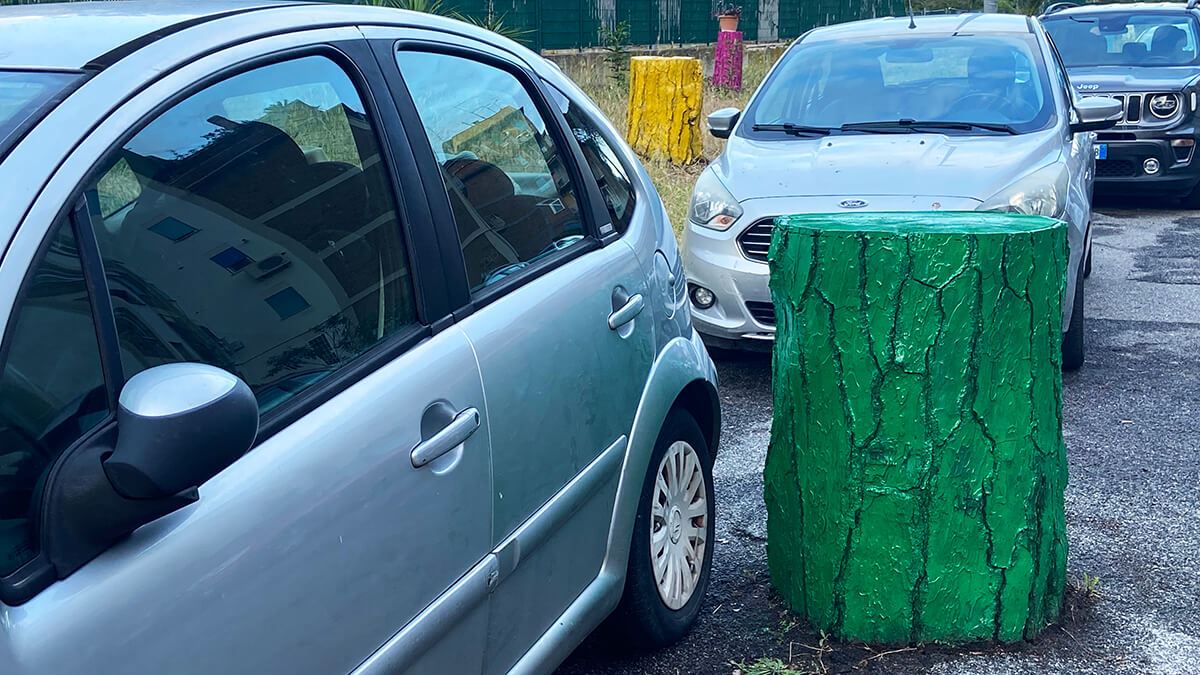
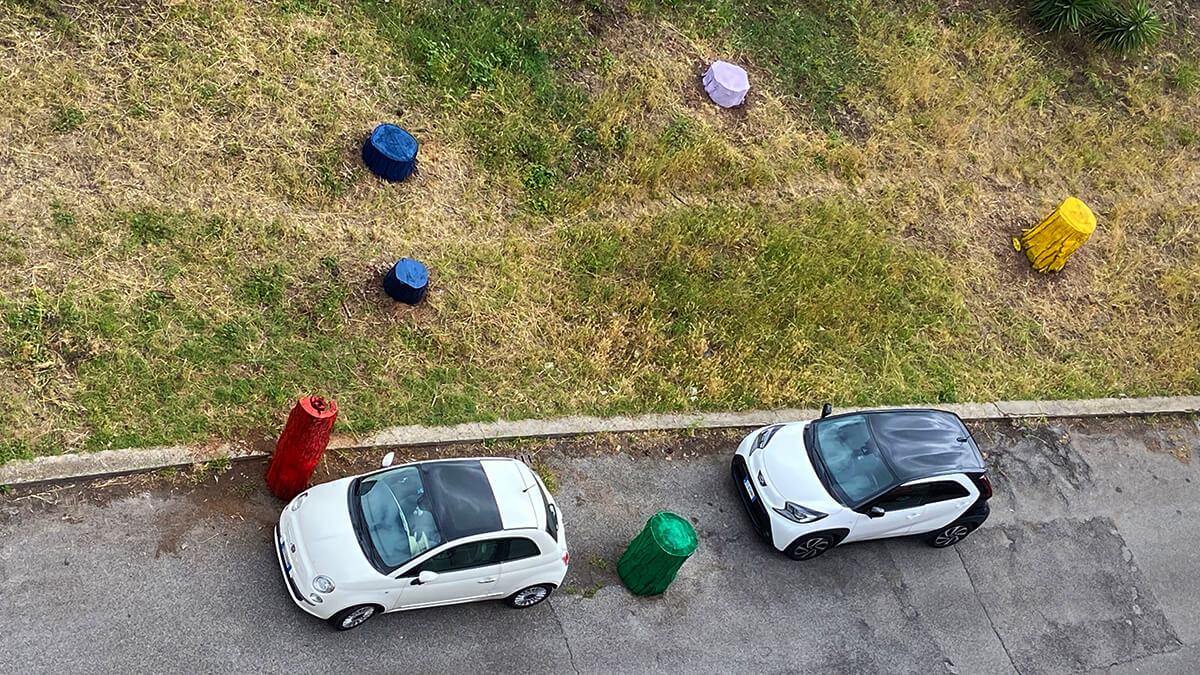
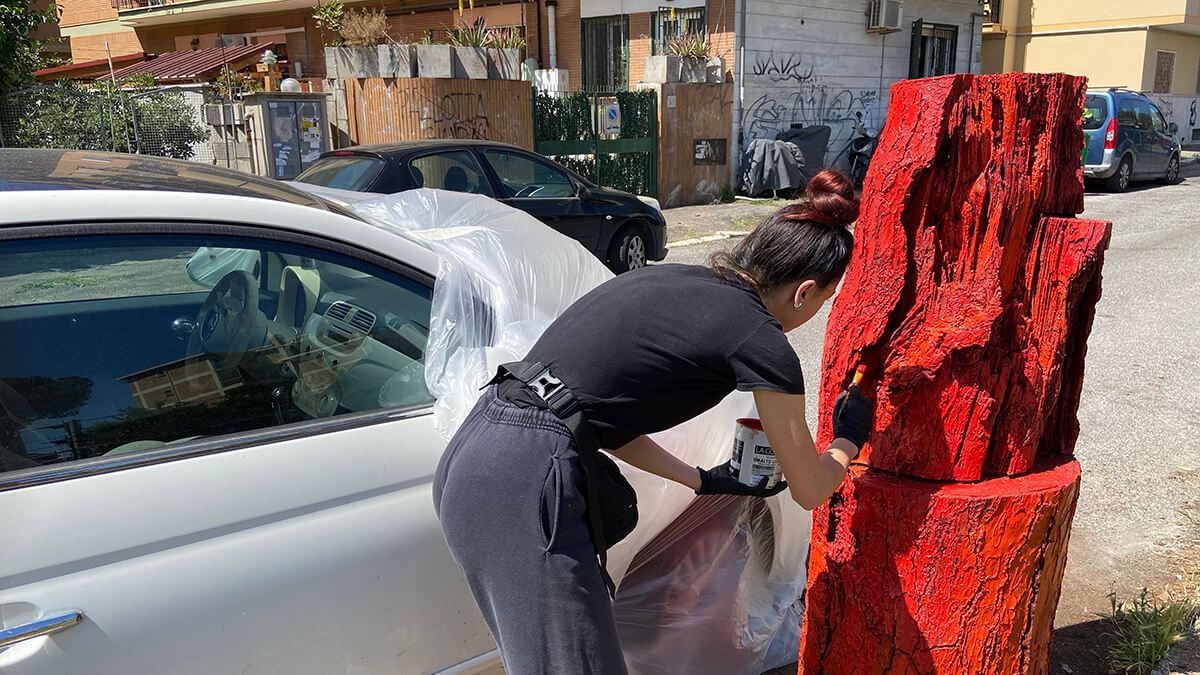
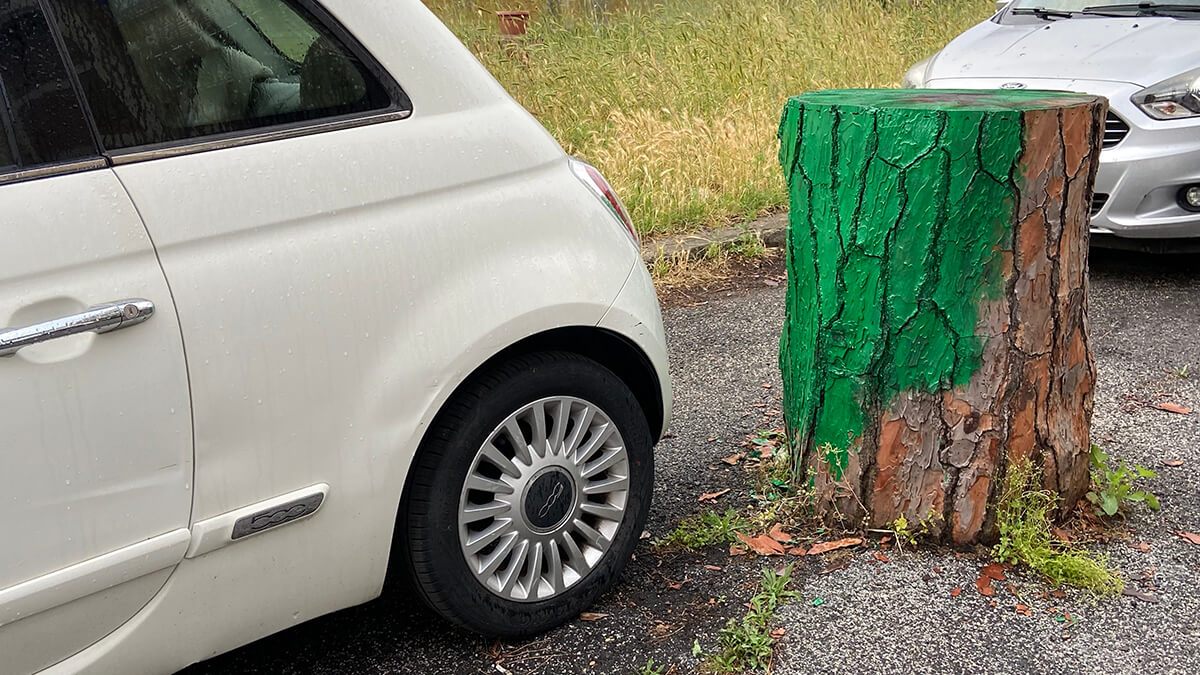
Another problem we encountered was cars parked in the immediate vicinity of the tree trunks that needed to be painted, some even parked just a few centimeters away from the stumps. In these cases, to avoid dirtying the cars while painting the trees, we protected the vehicles by covering them with large plastic sheets, as you can see in some production photos we included in the photo gallery.
Finally, on Monday the 11th, working all day with the entire team, with the exception of a brief break during the hottest hours and an additional trip to purchase additional materials, we managed to complete the installation.
Unfortunately, however, I wasn’t personally happy with the results achieved on two of the 12 stations, so Tuesday the 12th began with more purchase of new paint and “fresh” brushes, while we dedicated the afternoon to repainting the final two stations and performing a final cleaning operation.
I know, it sucks… Does it? I actually like it when things don’t go as planned and force me to test and experiment with new solutions and creative ideas, even if they require more time, effort, and money. Learning from mistakes is a classic; I call it a “nonlinear random process.” If a more complex and unexpected path is needed to get to my goal, I’ll take it (even if I “grumble” at times), but I’ll do it anyway. Come on!
The project concluded after creating the photographic documentation, a dedicated web page, and having two Forex plaques printed with basic installation information and QR codes for detailed information on the project website (in Italian and English). The two plaques were placed on the park railing, near the entry and exit stations, Station 1 and Station 12, on Thursday, May 14.
Curious to know the total cost of the project, which is entirely self-financed and clearly excludes transportation, manual and digital work days, and even breaks at the café? At the time of publishing this website, following the completion of production activities, the total cost for the construction of 12 Stations is €610. Future expenses for possible “maintenance adjustments” are not ruled out, likely to be carried out in spring 2027.

THE 12 STATIONS
Here are all 12 Stations of the installation, presented one by one, in order of their route.
The Stations were photographed before and after the intervention.
Move the cursor in the center of each image to the left and to the right to discover how each Station has changed, seeing them all before and after the street art intervention.
Enjoy your walk in the park!


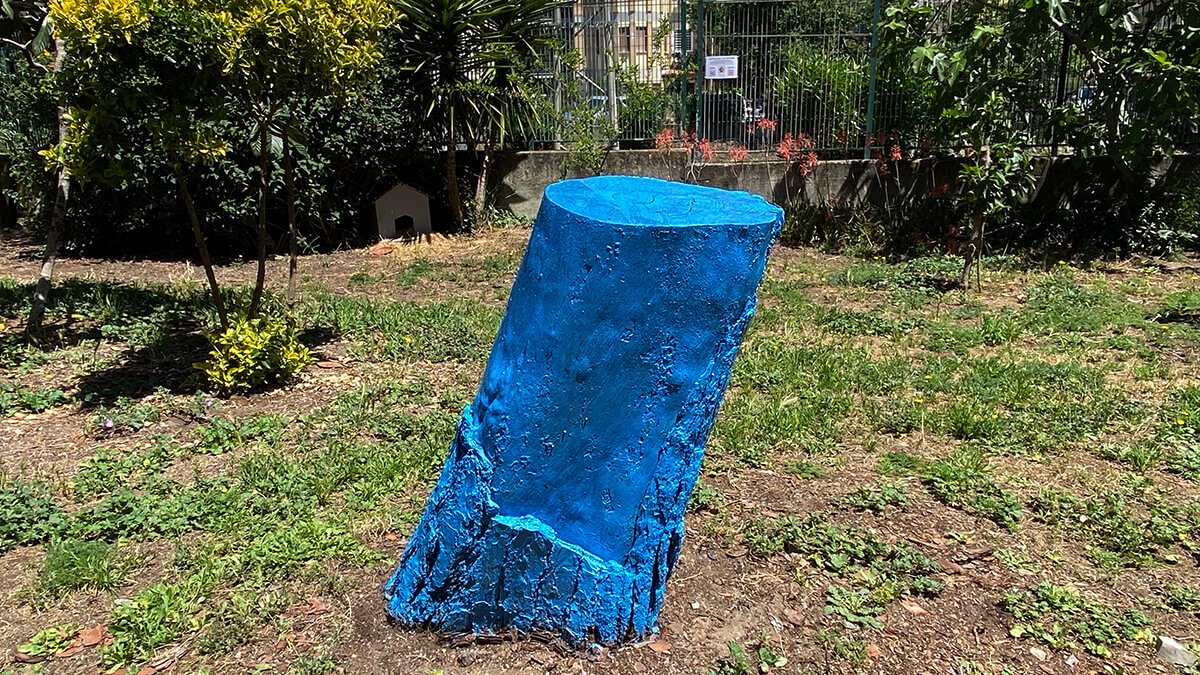
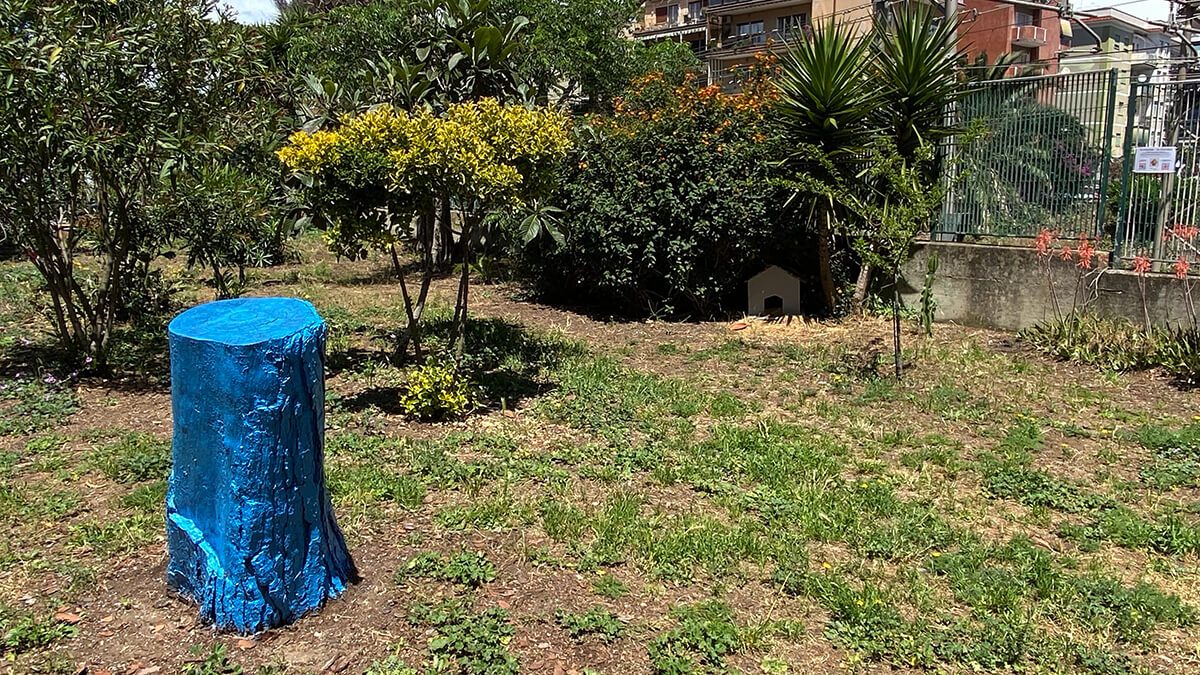
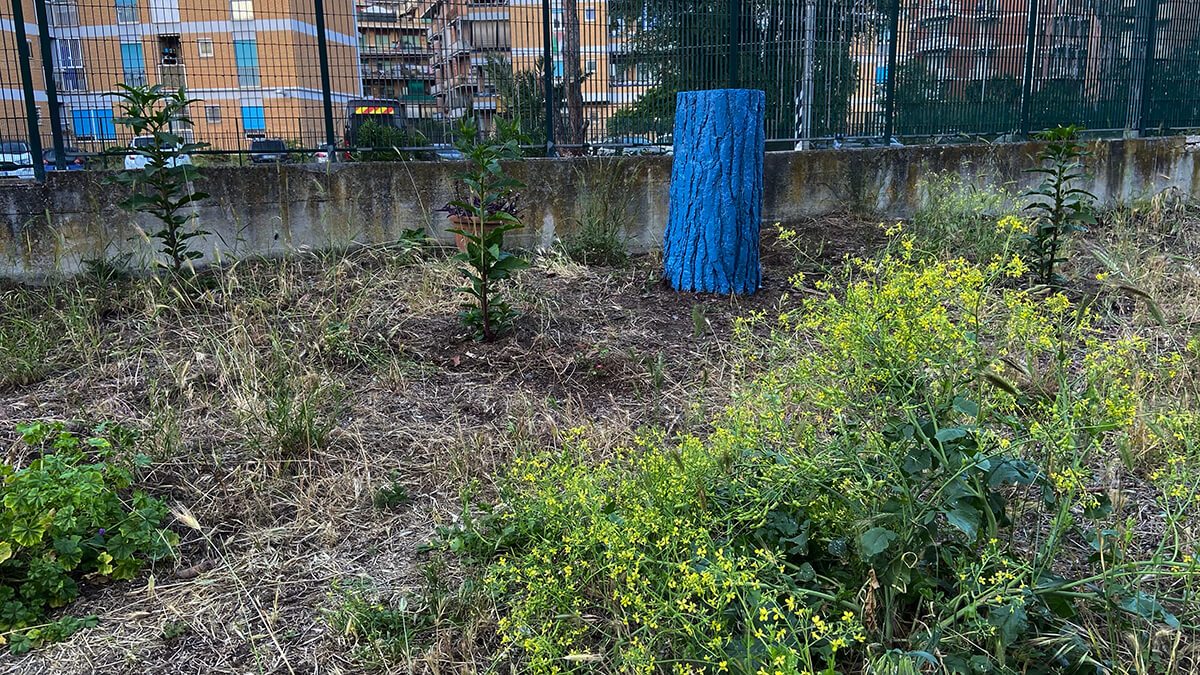
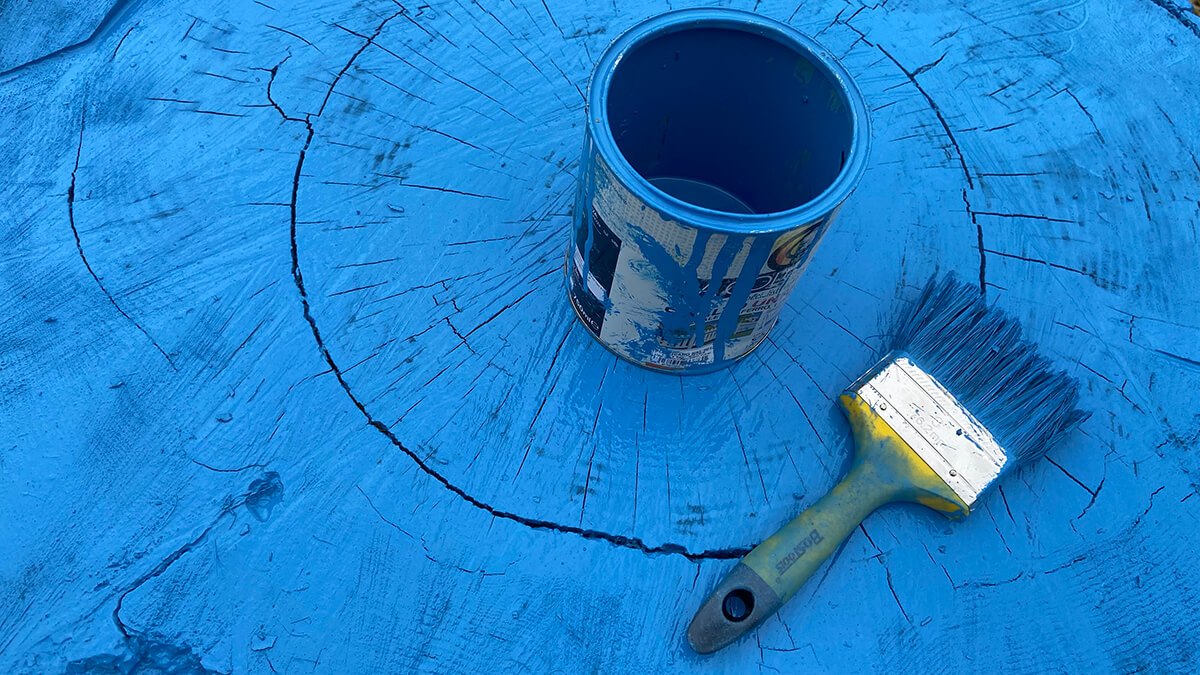
Station 1 is near the park’s only two benches, donated to the residents by a neighbor, not by the City of Rome. Station 1 is an oasis of tranquility, which I painted light blue/cyan.


STATION 2
Station 2 is a long-felled tree in terrible conditions. It’s been growing on the sidewalk in front of my house, and it is Davola’s first “pee station”. I painted it dark orange.


STATION 3
The tree at Station 3 was my favorite one. It grew luxuriantly in the middle of the asphalt, in front of my house. Its foliage provided a natural privacy screen for my terrace, which is now lost. It has been painted green.


STATION 4
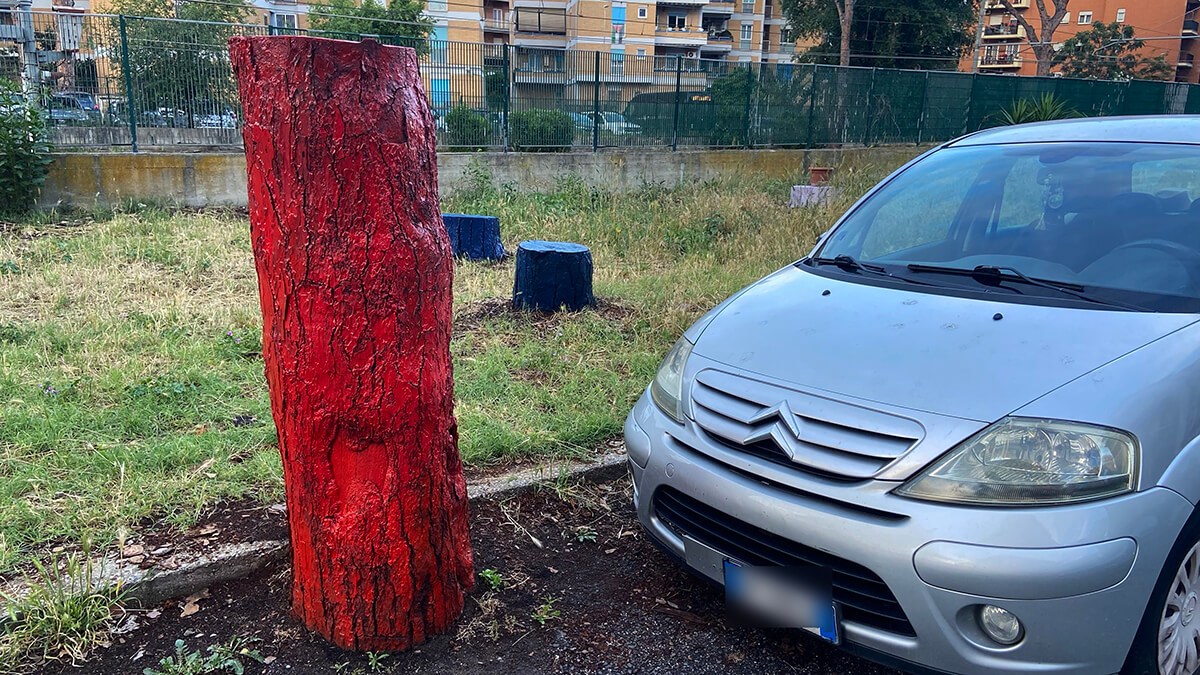
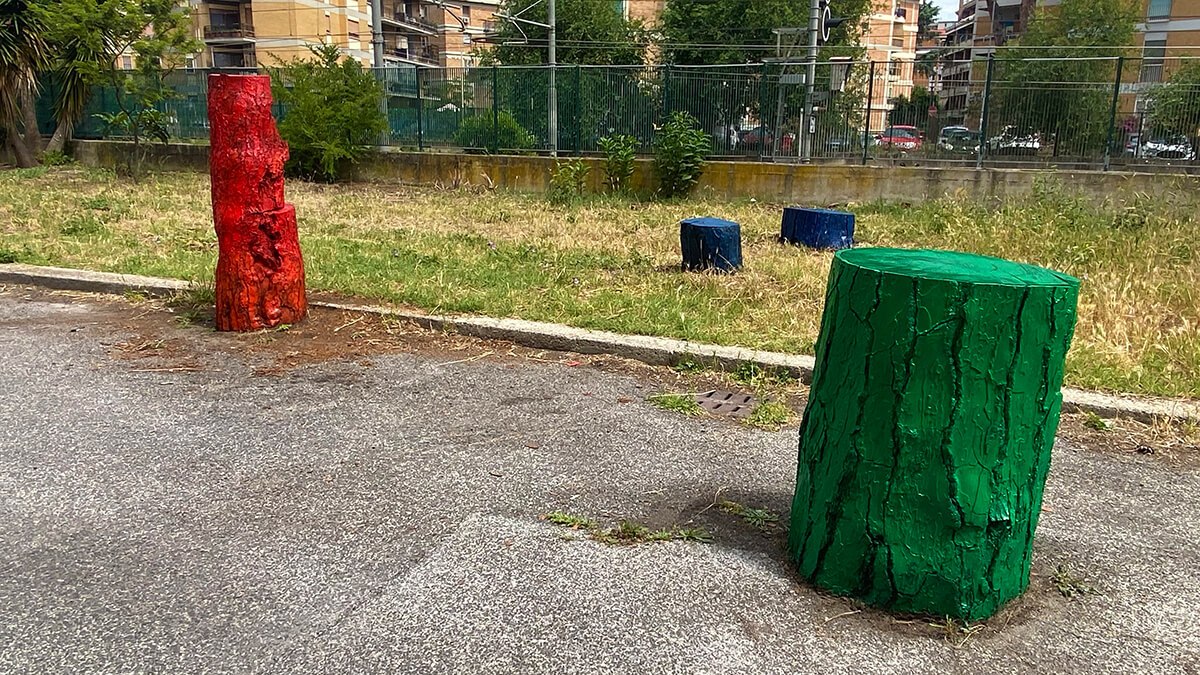
The tree at Station 4 grew in the asphalt, next to where I used to park my red camper van. In memory of the many adventures and road trips with my old camper van, I painted the tree stump bright red.


STATIONS 5 + 6
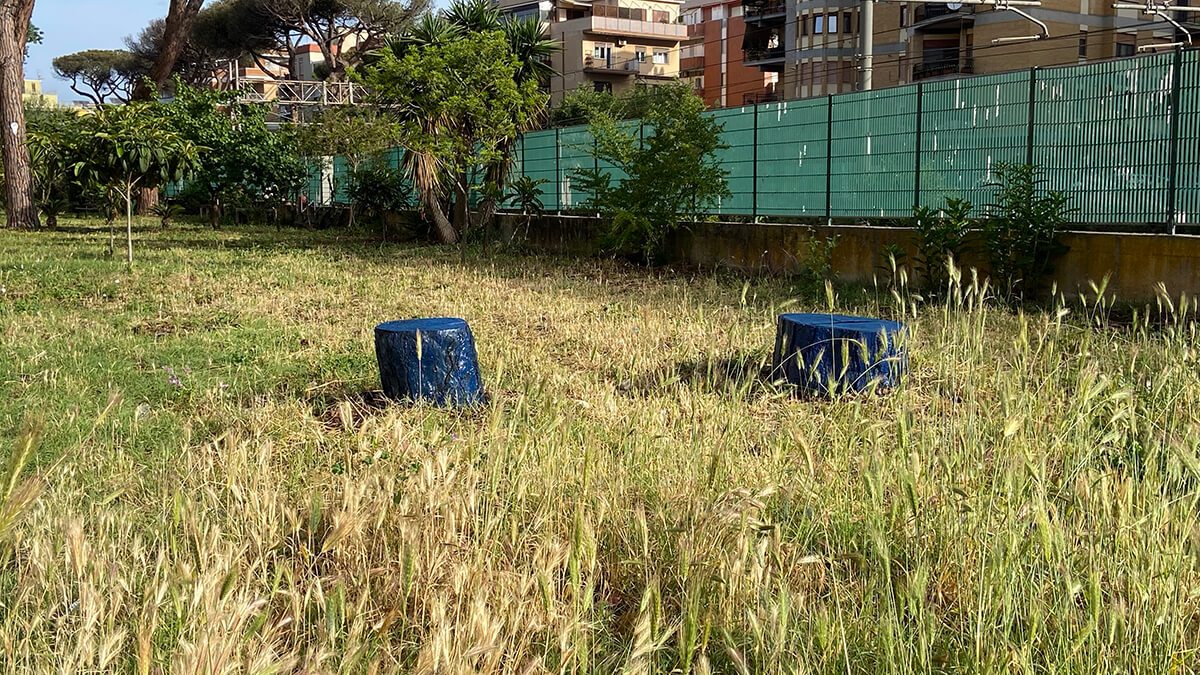
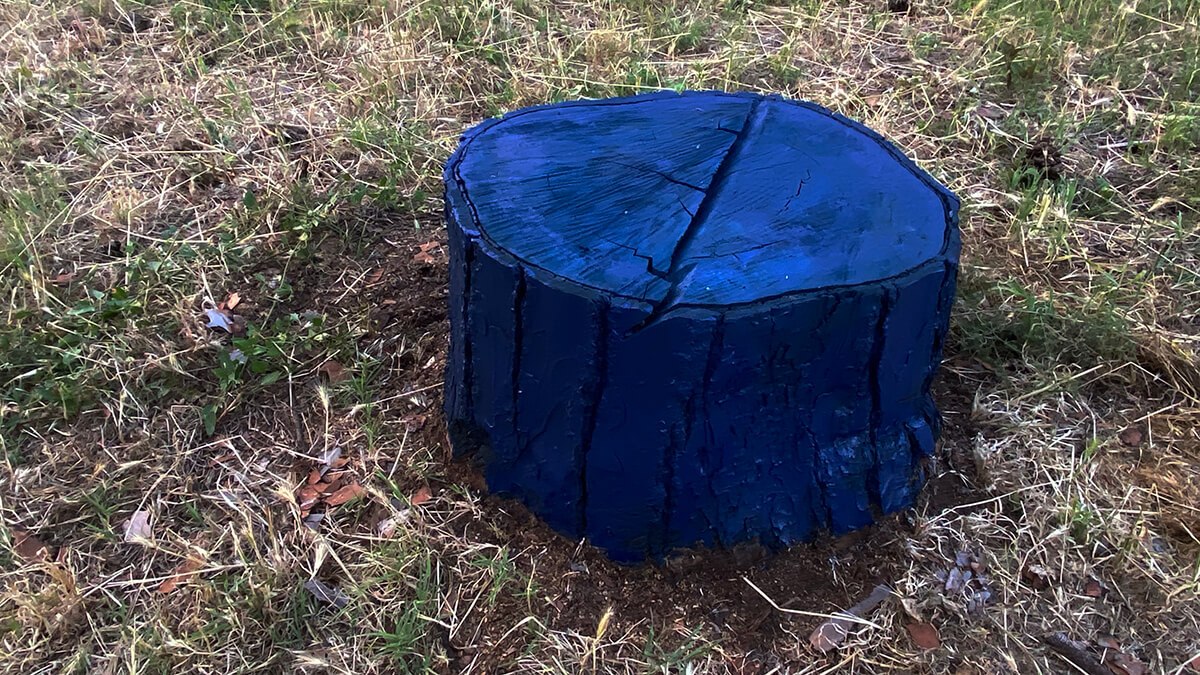
There was a spot in the pine garden path where you could pass between two trees. The twin stumps are still a virtual passageway in the residential garden. They were both painted ultramarine blue (deep blue).


STATION 7
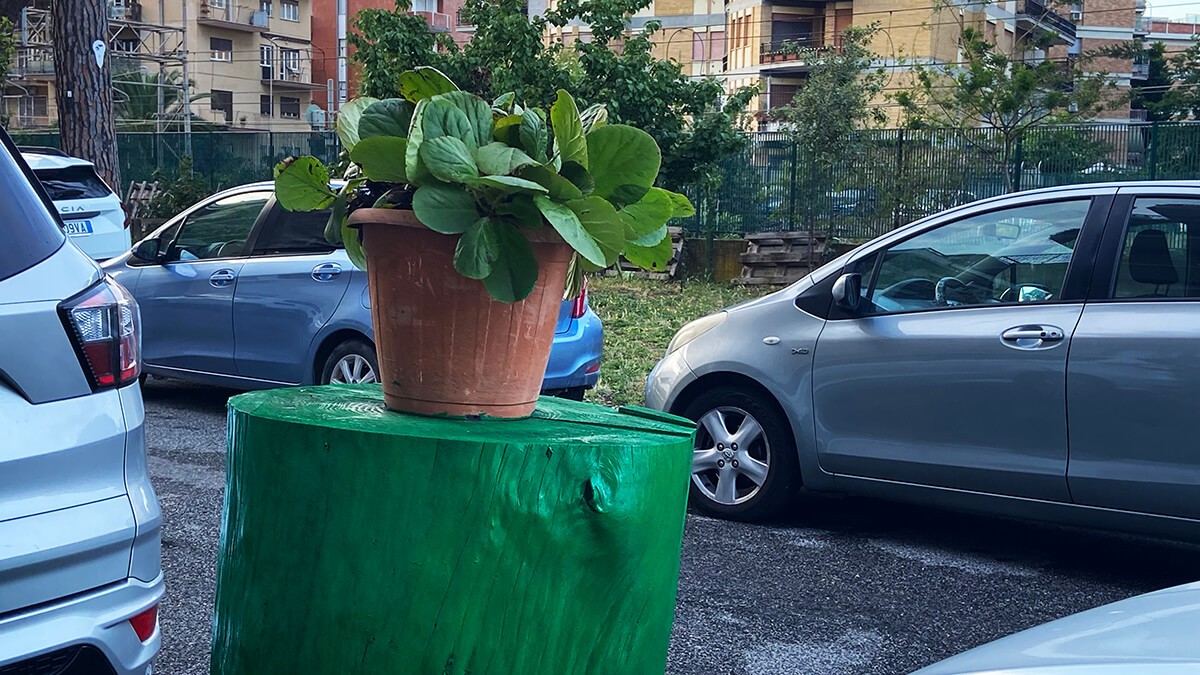
Station 7 is the lowest tree stump in the installation, decorated with a flowerpot placed by neighbors, like other stumps. Small and “cute,” it was painted “striped unicorn pink.”


STATION 8
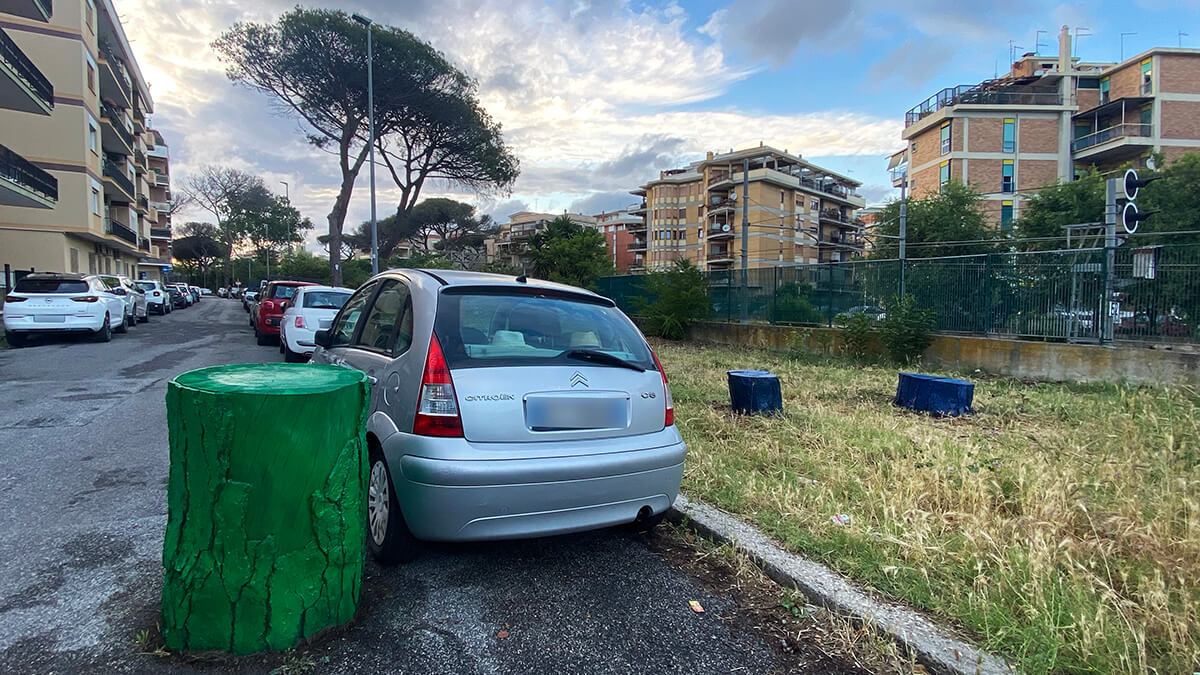
Another rebellious tree growing in the asphalt. The “asphalt trees” (minus the tree at Station 4) are painted green to celebrate nature’s resilience. and bring a little greenery to the asphalt.


STATION 9
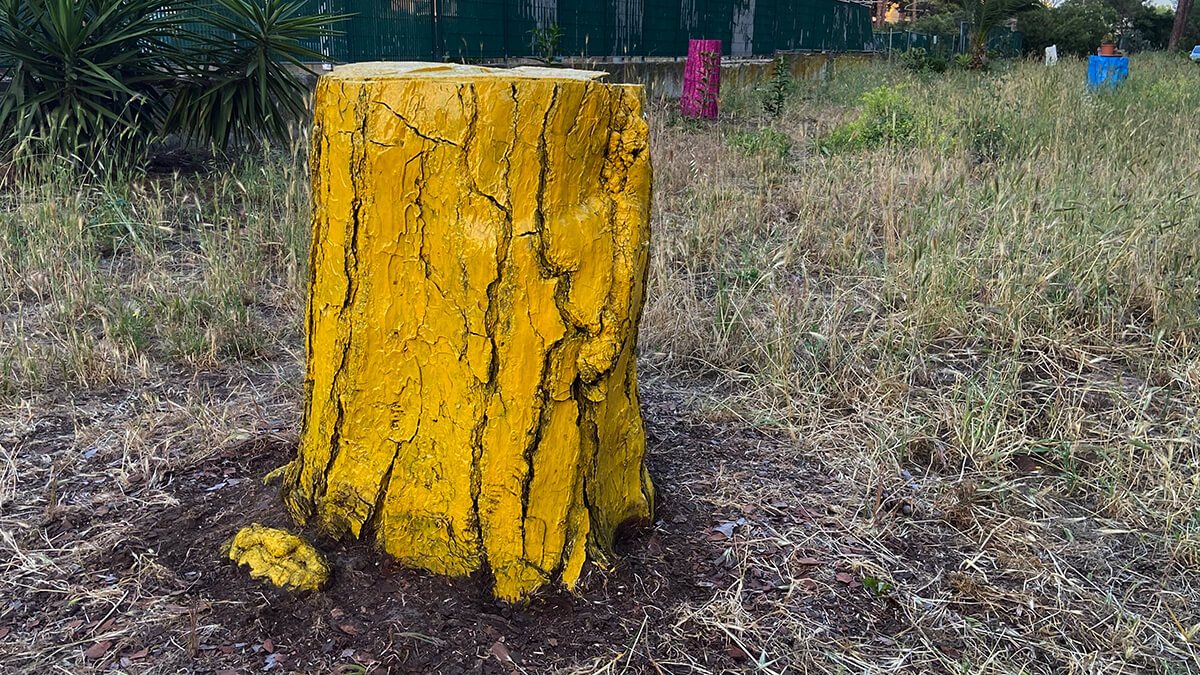
Station 9 stands proudly opposite the “twin stations.” Thanks to its central location, it gets plenty of sunlight all day long, and looks great in its new bright yellow appearance.


STATION 10
Station 10 has also become a stand for a flower pot, like many other tree stumps. Personally, I think this tree deserved better, and I decided to bathe it in a purple rain.


STATION 11
Station 11 is the ghost of a majestic pine tree, an oasis of cool shade in summer, and a goldmine of pine cones for Davola. As for “relax station” 1, I have chosen a light blue color.


STATION 12
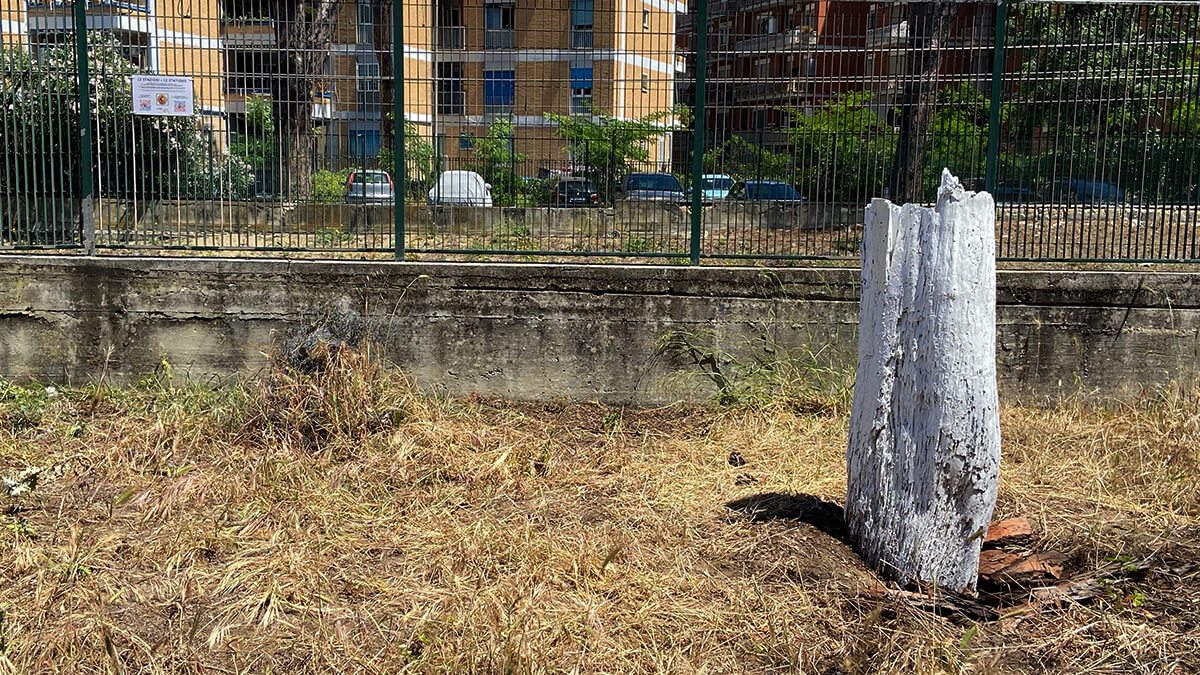
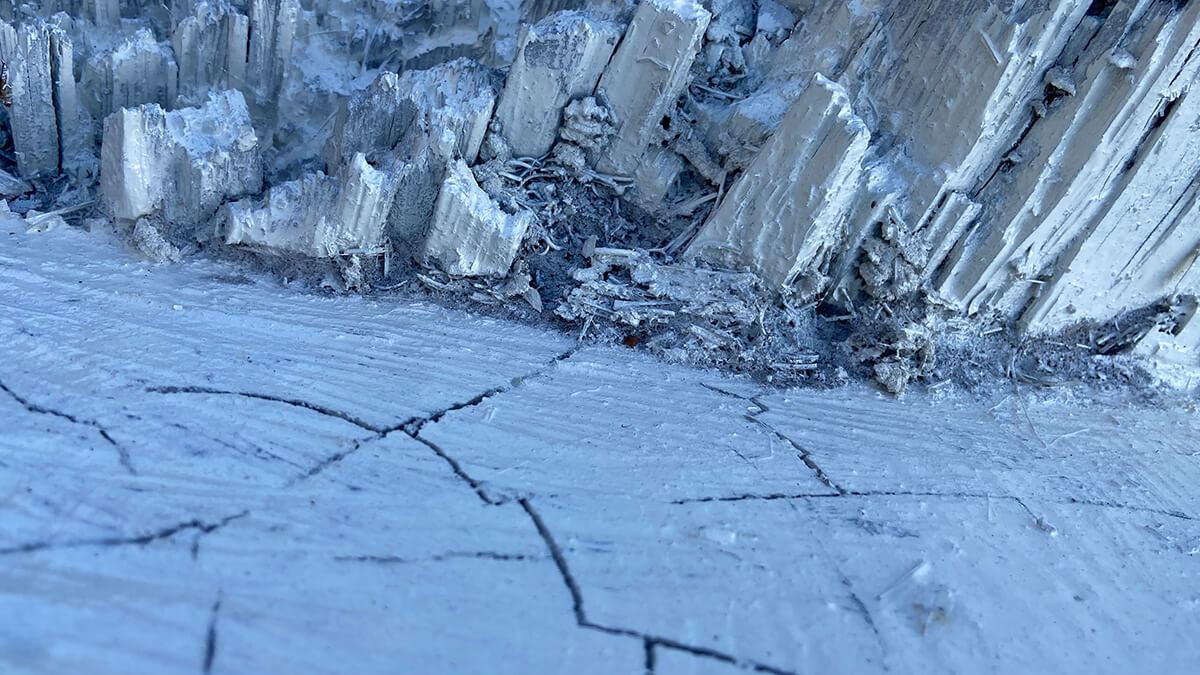
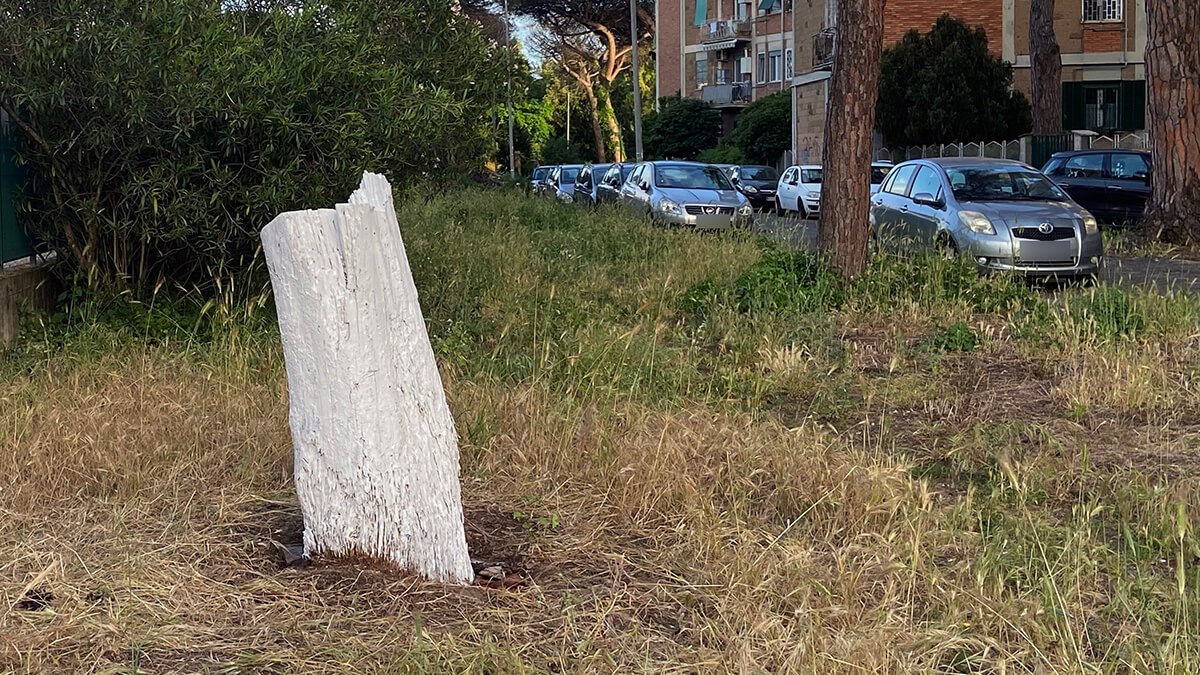
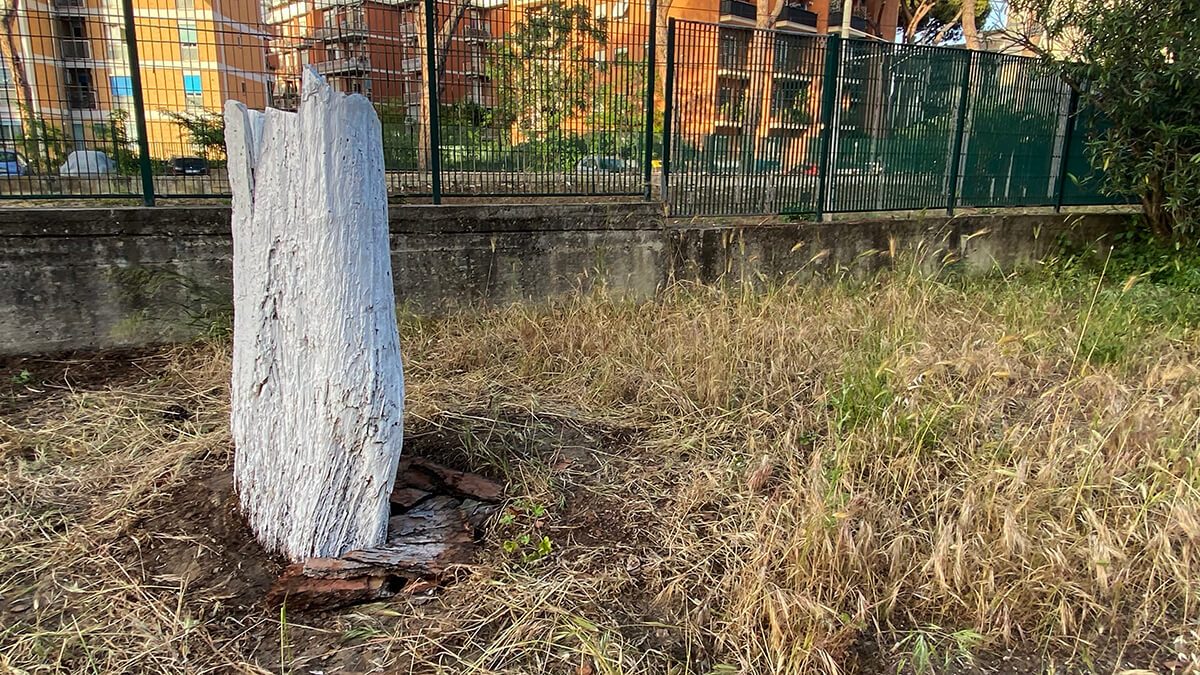
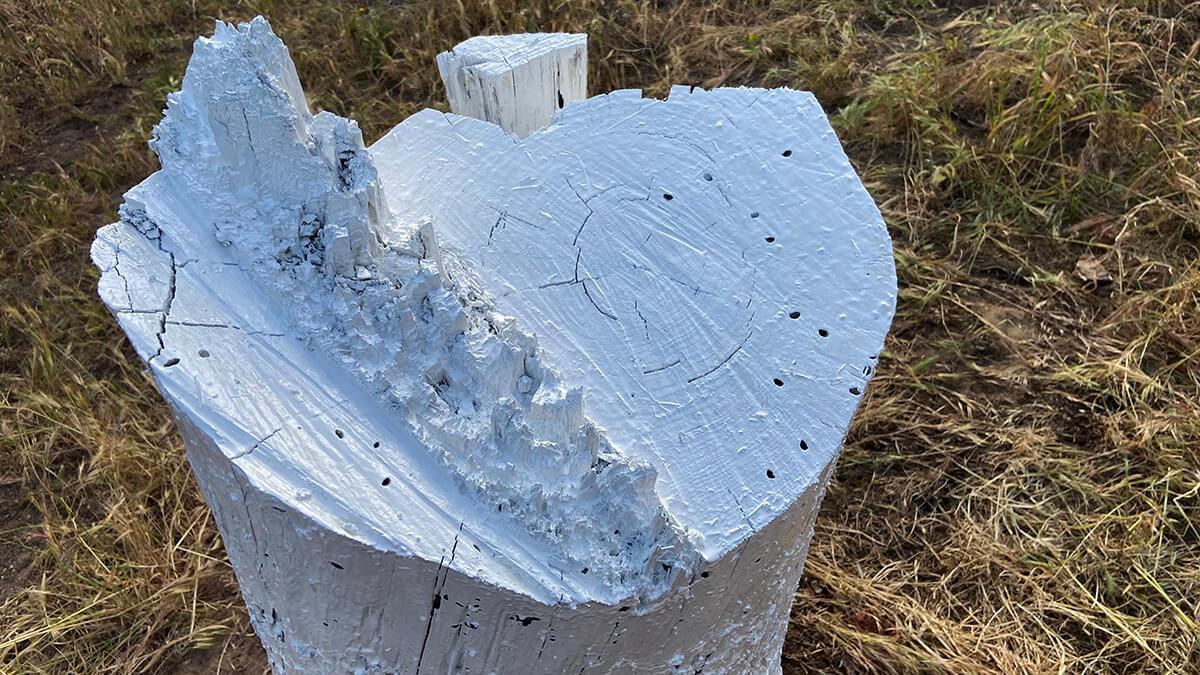
Station 12 is an old dead tree, which I painted white, the color of mourning in many Eastern cultures, and which transforms it into an iconic element of access to the memorial project.
PHOTO GALLERY
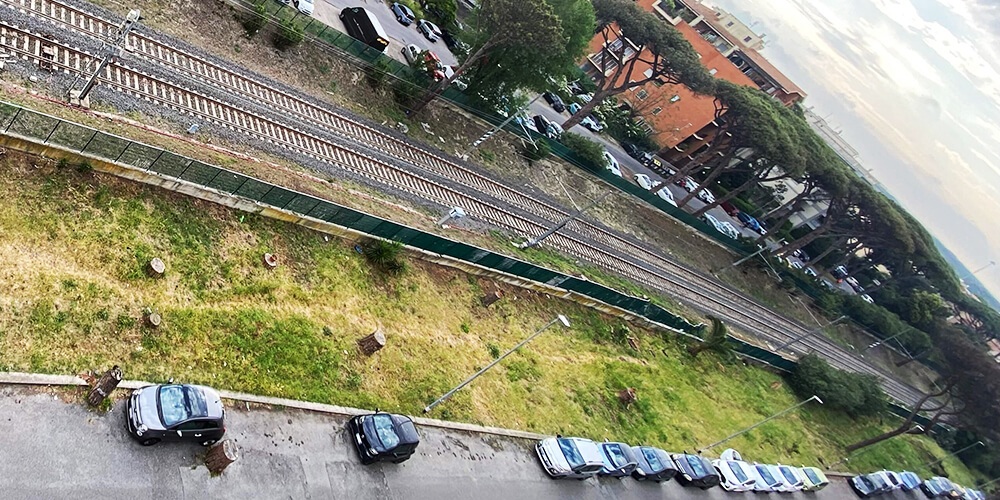
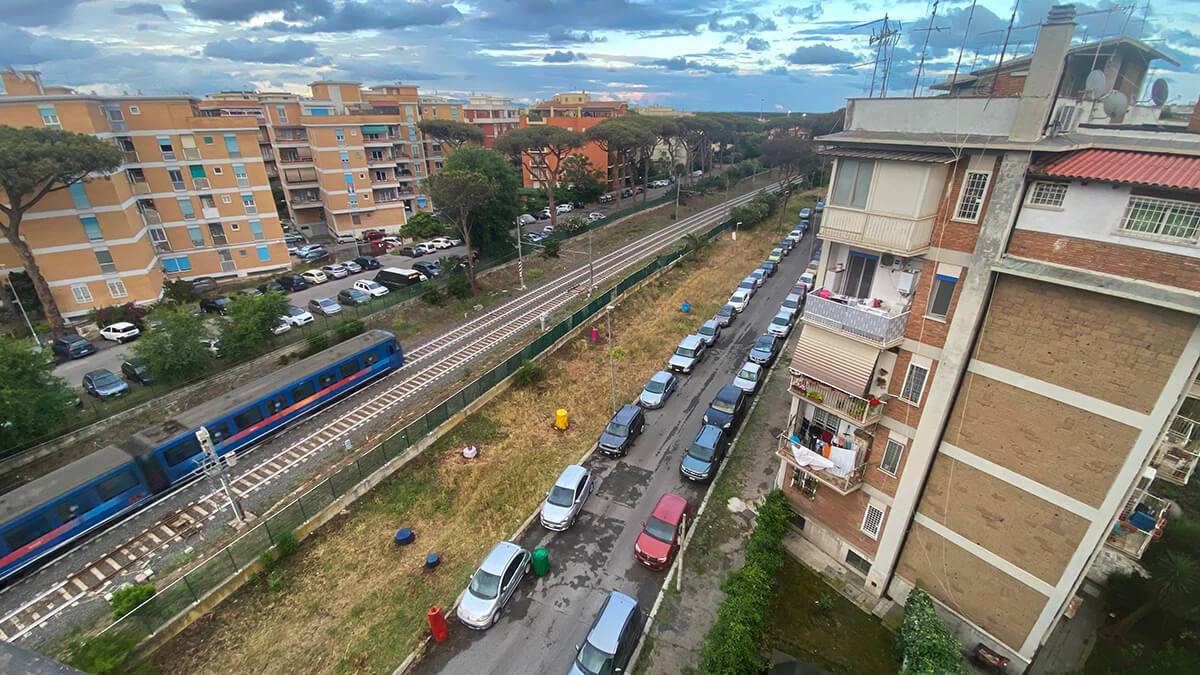
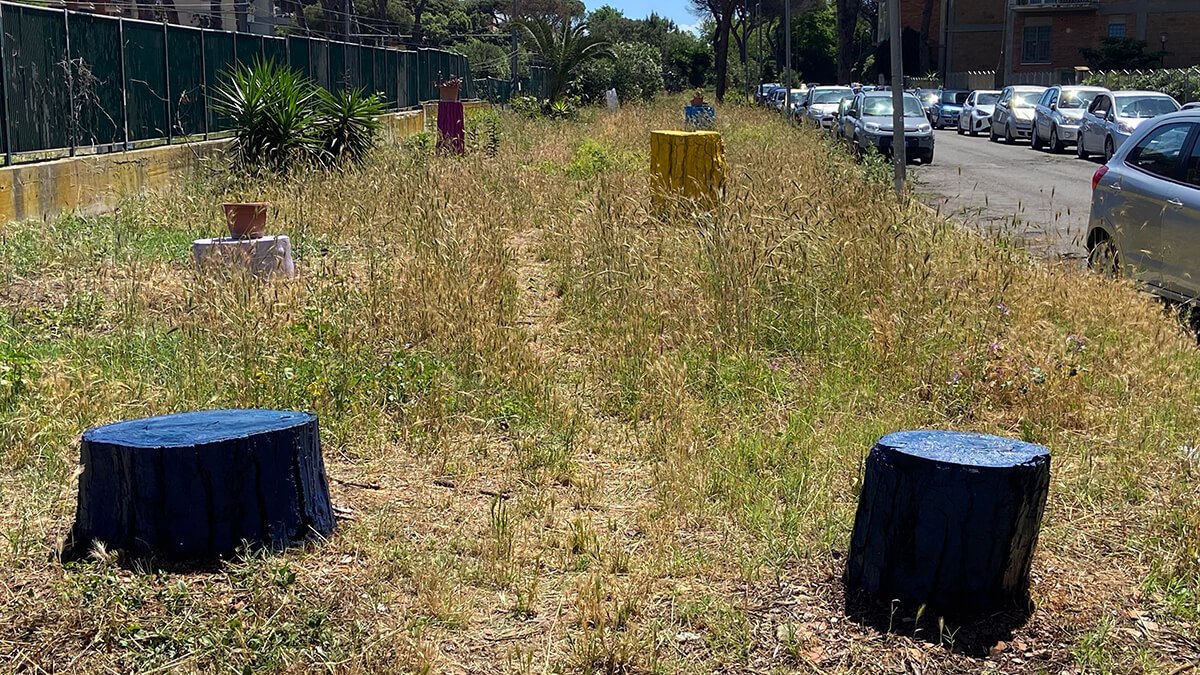
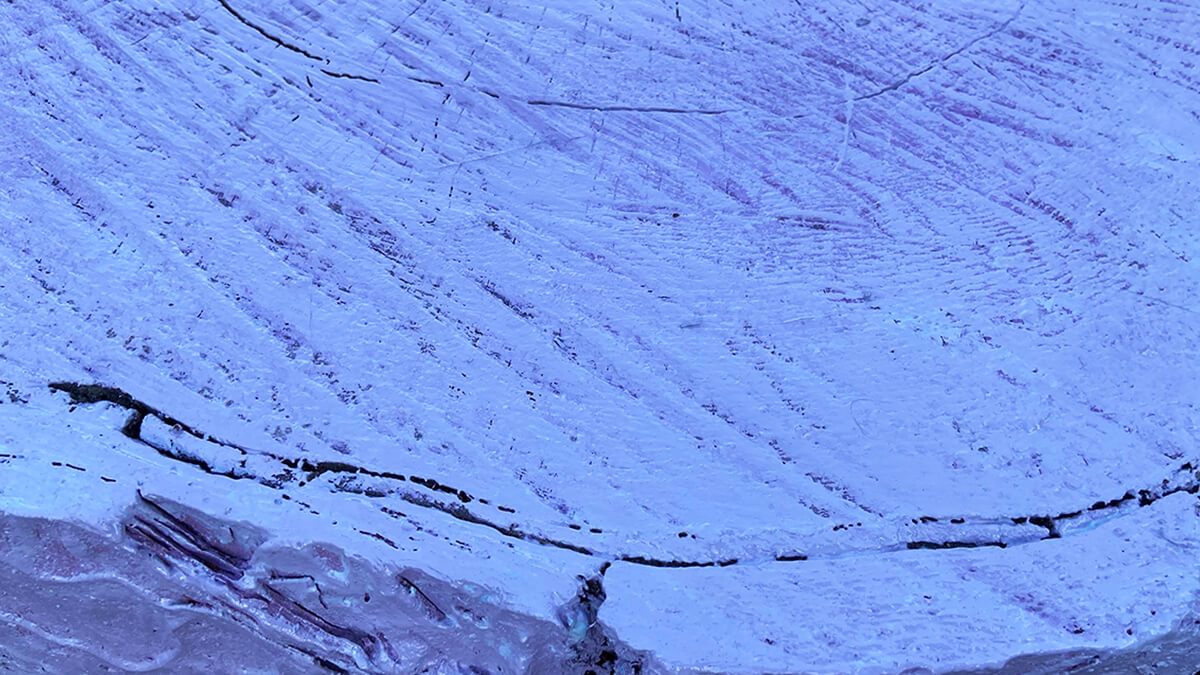
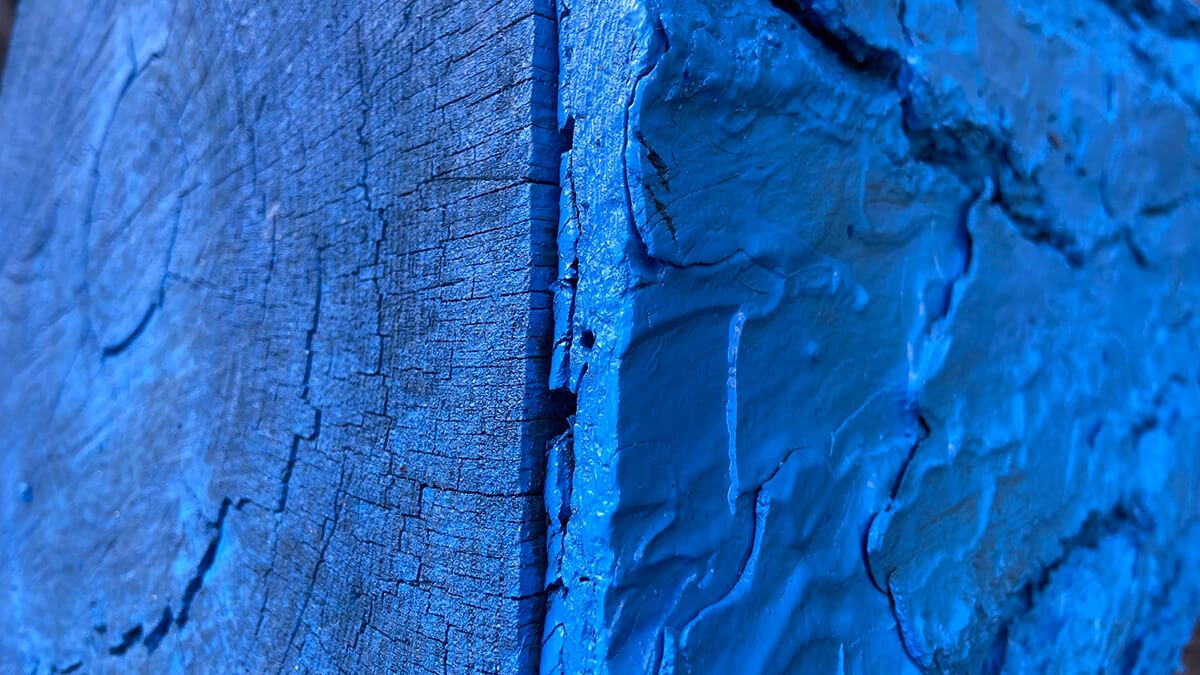
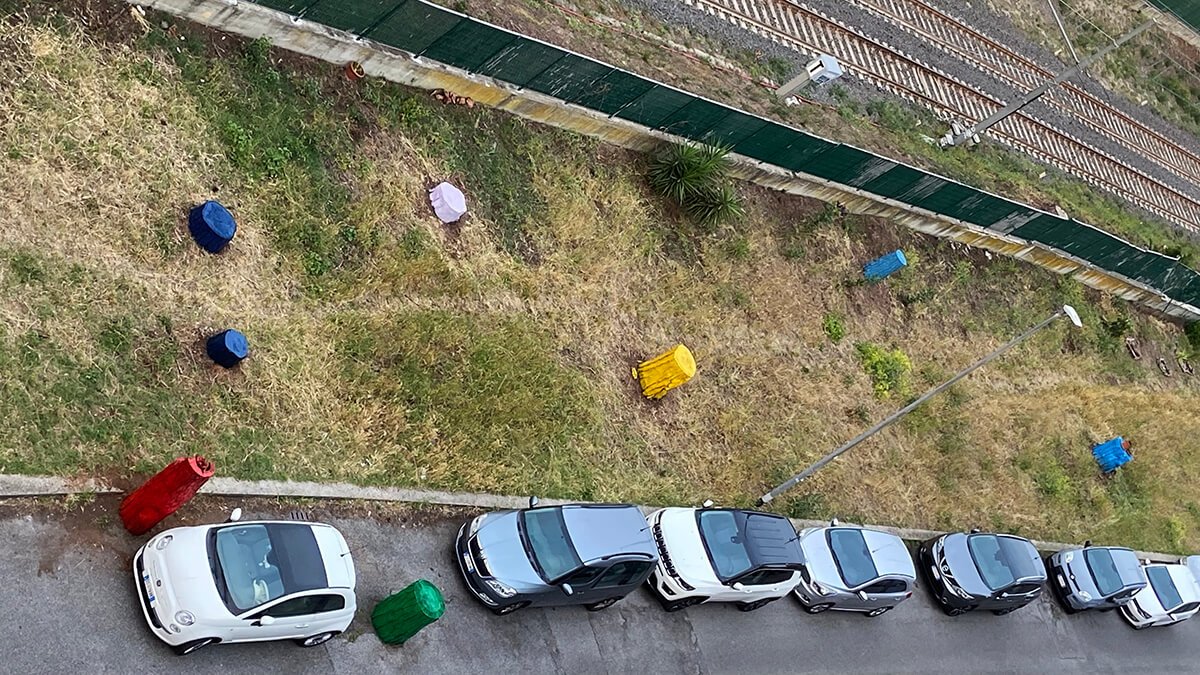
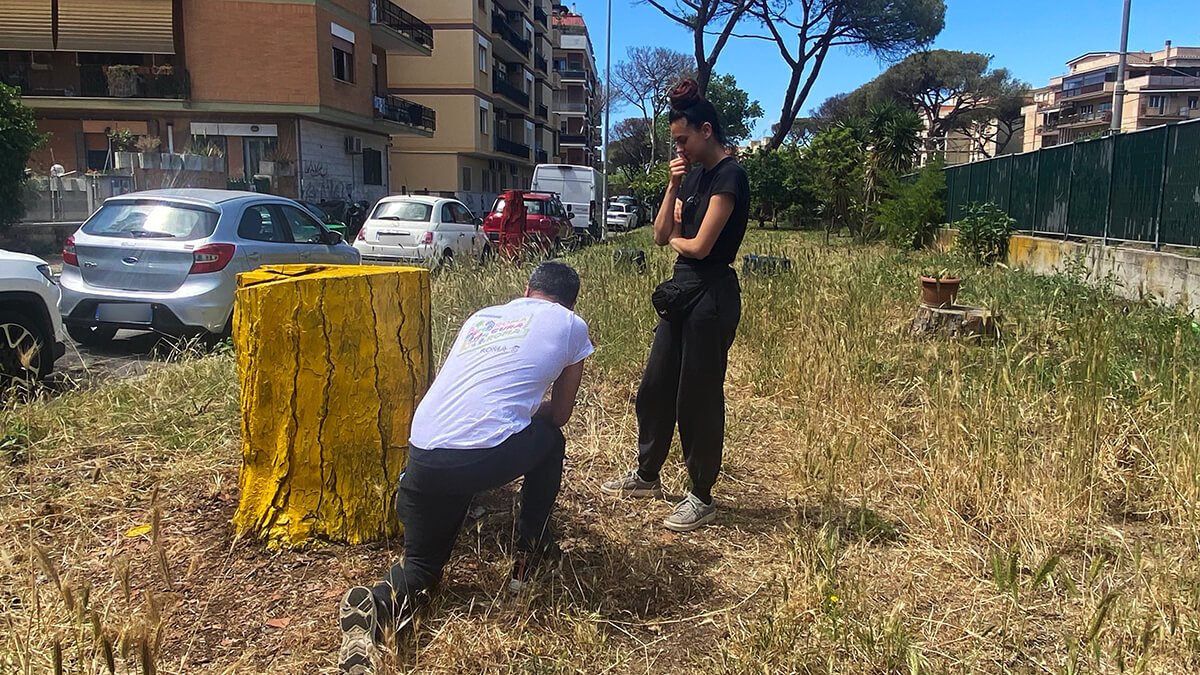
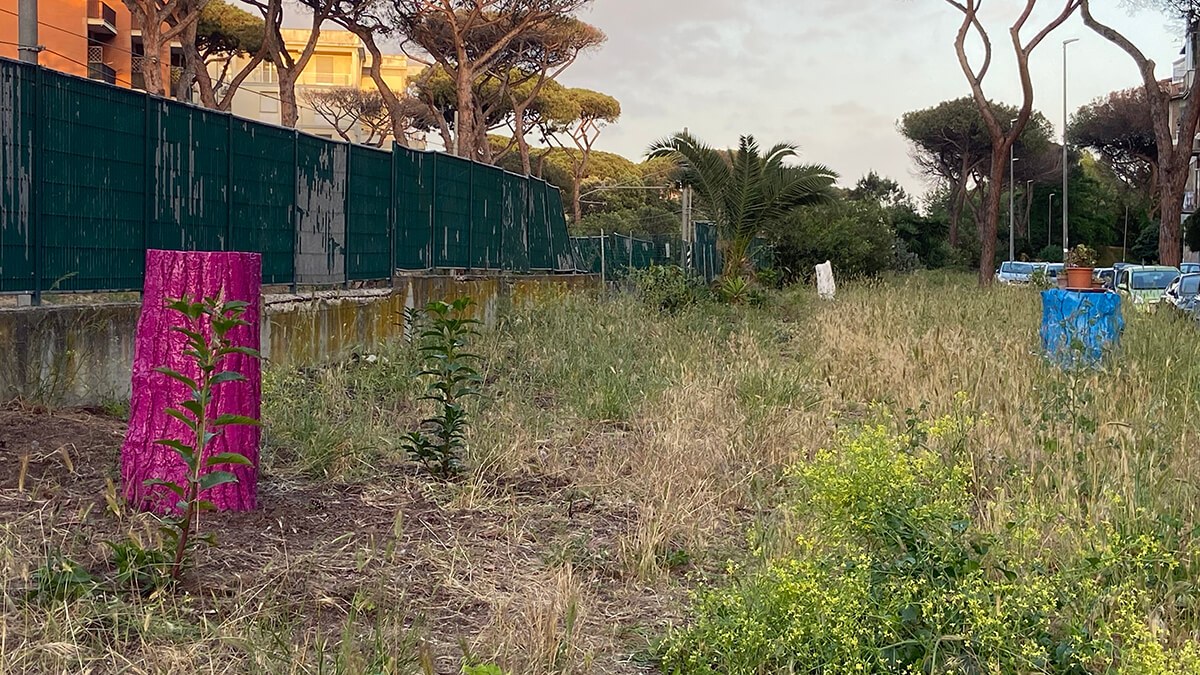
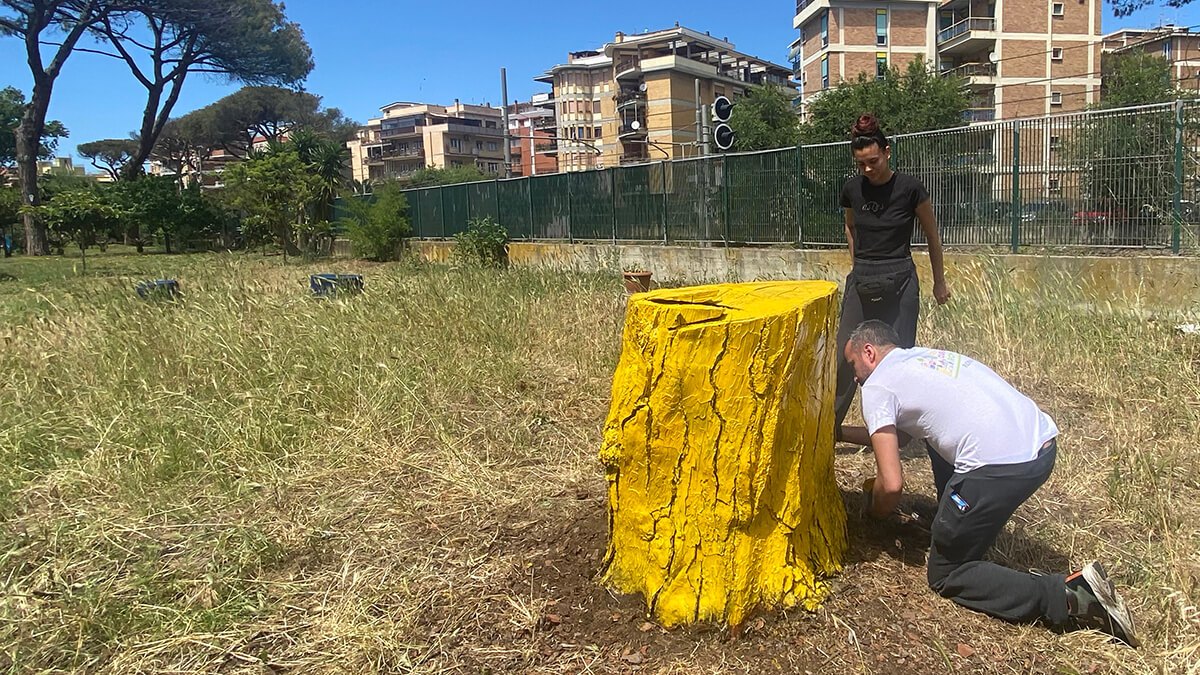
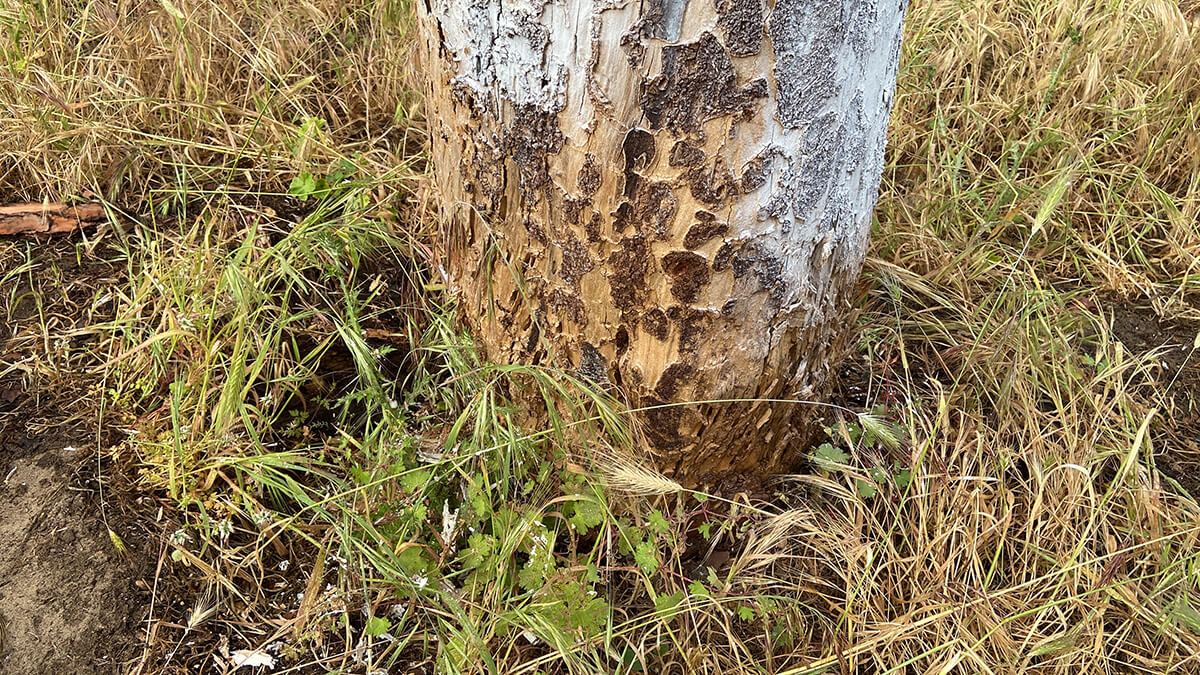
Click the images to access a full-screen photo gallery. A selection of images of production activities, and of the final installation, including site overviews, pictures of all stations, and intriguing details. You can manually navigate the galleries using the left and right arrows. You can also zoom in on each image to discover additional details.
Although we didn’t see any major privacy concerns, we decided to follow a web best practice by blurring and making unreadable the license plates of vehicles photographed near the installation elements, when visible.
We still haven’t had optimal conditions (or time) for better pictures of the installation. We will be keep adding new images to the photo galleries in the coming weeks. Follow the project for updates.




























































THANK YOU
Thank you to all the trees that are no longer here, for making my stay in Ostia so pleasant and for being a source of inspiration for this project.
Thank you to my dog Davola, for “showing me the way” among the trees and for all the wonderful moments we spent together, in the park on Via Gregoretti and throughout the world.
Thank you to Arianna, for her infinite patience and support in all my follies, and for “volunteering” to help me with the project (not true, I “designated her as my project assistant, and she accepted immediately). Thanks also to Franco for joining the project team in time for the final realization.
Thank you to all the neighbours on Via Gregoretti who take care of the park, making up for the lack of maintenance and cleaning of the green area, and who are doing everything they can to restore the residential garden to a pleasant green space again, after the trees were cut down (and actually even before).
Thanks to the City of Rome for the organization of “Roma Cura Roma,” which has revealed to be the perfect framework for this project, and for its aim to bring back grace to a lost green area, thanks to an art installation. Even though the support for materials was lacking.
Finally, thanks also to my glorious red camper, now gone, for being my companion on a thousand adventures “on the road“, an unmissable reference point for those passing through Via Gregoretti, and the “guardian of the trees” for so many years. We will miss you too and you will not be forgotten, dear “casita con ruedas“.

CONTACTS AND LINKS
Email
burningmax@gmail.com
Web (this dedicated 12 STATIONS website)
burningmax.com/art-projects/12-stations-2026-english
Web (12 STATIONS website in Italian)
burningmax.com/art-projects/12-stations-2026
Web (link to Burningmax art projects)
burningmax.com/art-projects-timeline
Instagram
@burningmaxcreative
Where is the installation

© BURNINGMAX 2026